
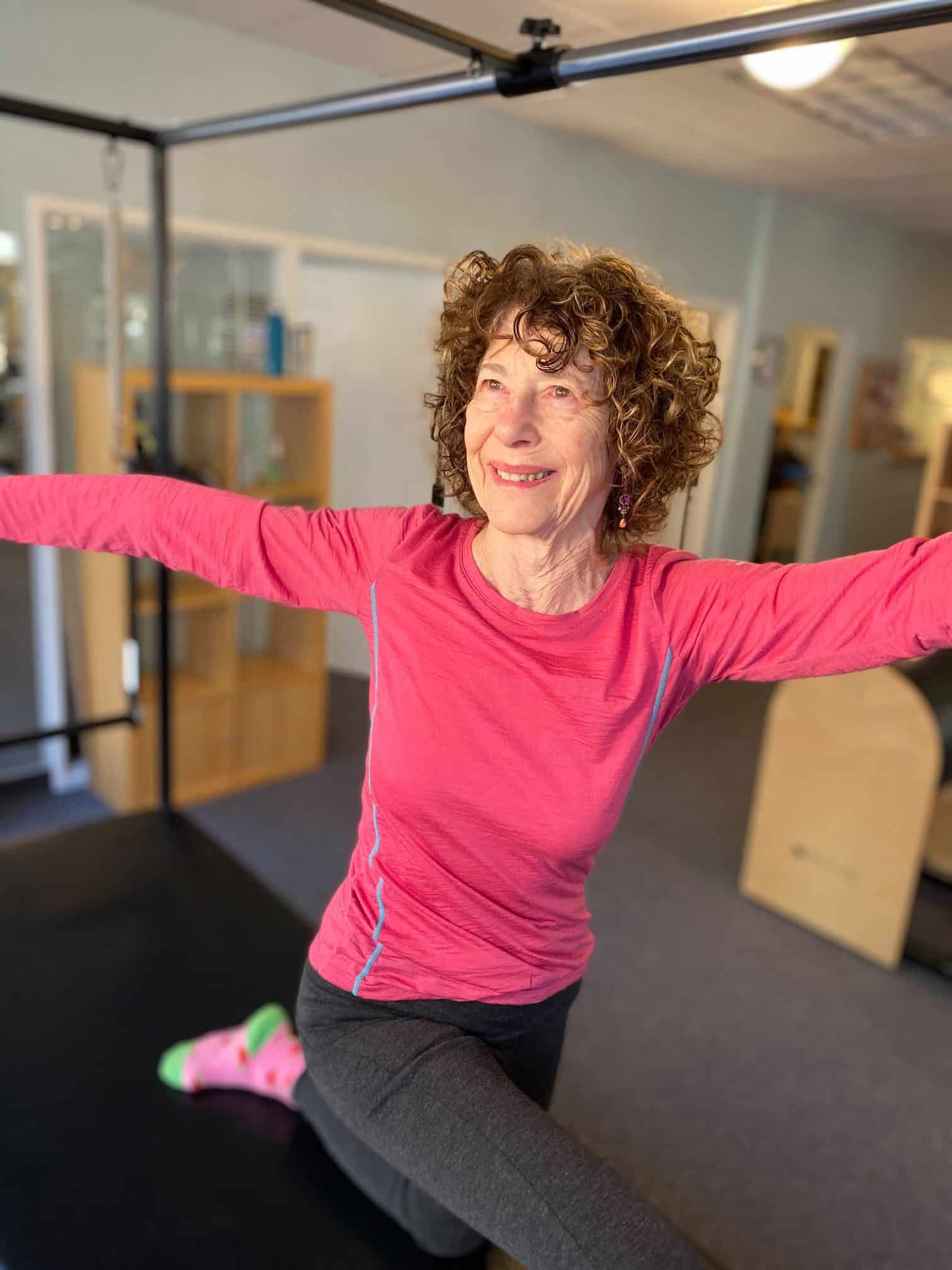
Most research on aging actually studies inactivity, not age itself. Studies on people who stay consistently active show markedly different outcomes — stronger muscles, denser bones, sharper cognition — well into their 70s and 80s.
There’s a story most of us have absorbed about getting older: you peak somewhere in your 30s or 40s, and after that, it’s a slow, steady decline. Stiffer joints. Less strength. Less capability. At some point, you’re just supposed to accept it.
It shows up everywhere. “Don’t get old — it’s terrible.” “My doctor says it’s just my age.” We hear it from clients here at our Pilates studio in Portland, Oregon, from friends, from family — and most of us have caught ourselves saying it too.
But the story deserves a second look, because a lot of what gets labeled “aging” is really something else entirely.
Does Aging Actually Cause Physical Decline?
Much of what’s commonly attributed to aging is more accurately explained by inactivity. When researchers study people who stay active, decline is far less pronounced — or doesn’t appear at all.
Here’s something that doesn’t get talked about enough: a large share of what we “know” about aging comes from research on people who don’t move very much. And if you study a population that’s largely sedentary, you’re going to find decline. That’s not really a study of aging — it’s a study of inactivity wearing a costume.
When researchers instead look at people who’ve stayed consistently active — not professional athletes, just regular people who kept moving through their 60s, 70s, and beyond — the picture looks very different. Muscle mass holds up. Bone density holds up. Cognitive function holds up.
That’s not an outlier. It appears to be closer to what the human body is actually capable of, given the chance.
What Happens Inside the Body When You Stay Active?
Bone and muscle act like endocrine organs during exercise, releasing signaling proteins — including osteocalcin — that researchers have linked to memory, cognitive function, and long-term brain health.
For a long time, bones and muscles were treated as mostly structural — scaffolding and an engine, nothing more. Newer research paints a more interesting picture: they also communicate, releasing proteins into the bloodstream that influence how other systems function. Scientists have started calling one piece of this the “bone-brain axis” — a real, active line of communication between how you move and how your brain works.
One of the better-studied messengers in this system is osteocalcin, a hormone released by bone. Circulating osteocalcin rises during exercise, and researchers have linked it to memory and spatial learning — with levels tending to decline with age and inactivity, and cognitive performance often following a similar pattern. Some researchers now consider osteocalcin a candidate marker for tracking healthy aging over time, precisely because it responds so directly to how much a person moves.
Bone isn’t communicating with the brain in isolation, either. Researchers describe an interconnected loop between bone, muscle, and brain, where signals in one system influence the others — meaning consistent movement doesn’t just strengthen the tissue doing the work, it appears to support the whole network.
How Does Muscle Send Signals to the Rest of the Body?
Working muscle releases its own set of proteins, including klotho, which researchers study as a marker of long-term resilience and have linked to protective effects on the heart, brain, and muscle over time.
Muscle turns out to be just as communicative as bone. Contracting muscle releases proteins — often called myokines — into the bloodstream, and one of the most studied is klotho, sometimes referred to in the research literature as a longevity protein.
Klotho has been associated with protecting against muscle loss, supporting bone density, and buffering cardiovascular and cognitive decline. Several studies have found that a single bout of exercise measurably raises circulating klotho levels, and researchers are actively studying whether sustained, moderate activity over time helps maintain higher baseline levels as people age — as opposed to occasional extreme exertion, which some research suggests may not carry the same benefit.
None of this is settled science with tidy cause-and-effect answers — researchers are still mapping out the full mechanisms behind both osteocalcin and klotho. But the direction of the evidence is consistent across both: movement keeps this internal signaling active. Inactivity lets it go quiet.
Is It Too Late to Start If You’re Already in Your 60s or 70s?
No. Midlife arrives earlier than most people expect, and the years that follow are longer than most people plan for — which means there’s real runway to change what those years look like, starting now.
One of the most common hesitations we hear from people considering Pilates for the first time is some version of, “I probably should have started years ago.” It’s an understandable worry. It’s also not supported by what actually happens when people start.
At our studio in Portland, we see it regularly: clients in their 60s, 70s, and 80s discovering strength and mobility they didn’t expect to have. Getting up from the floor more easily. Standing taller. Traveling with less dread about how their body will hold up along the way. It’s one of the most rewarding parts of this work — and it doesn’t happen only for people who started young. It happens for people who started now, whenever now happened to be.
Long-time PNWP client Roberta Margolis, now 83, put it simply: “I shudder to think where I’d be physically without Pilates.” Donna Jordan, a client for 23 years, says much the same thing about staying capable well past the age most people assume that’s still possible: “Thanks to Leslie, Melanie, and the whole crew — I am still moving at 79!”
What Role Does Pilates Play in Healthy Aging?
Pilates builds mobility, balance, alignment, and deep postural stability — the specific qualities most closely tied to functional independence later in life — making it a strong foundation for staying active overall.
“Reverse aging” isn’t a phrase we’d use — it overpromises in a way that doesn’t hold up under scrutiny. But “maintain and build function at any age” isn’t an exaggeration. It’s what the research on active older adults consistently points to.
This is where a practice like Pilates does something genuinely useful. Building mobility, improving balance, refining alignment, and developing deep postural stability keeps the whole system — muscles, bones, brain — engaged in the kind of signaling described above.
Pilates isn’t the only piece of a physically active life, and it shouldn’t be presented as one. But for many Pacific Northwest Pilates clients, it’s the foundation that makes everything else — hiking the Gorge, a round of golf, travel, keeping up with grandkids — safer, more sustainable, and more effective over the long run.
What Should You Do Next?
If any of this resonates — the frustration of “it’s just my age,” or the sense that you’d like more runway ahead than that story allows for — the next step doesn’t need to be dramatic.
A good starting point is understanding how your own body currently moves and what a thoughtful, personalized plan could look like from here.
Book a Free Chat with our team to talk through where you’re starting from.
New to Pilates or the Reformer? Our Quickstart Series is a small-group, four-week introduction built for exactly this stage — no experience required.
Prefer to ease in with more information first? Join our newsletter for more research-backed, no-nonsense looks at movement and aging.
FAQ Section
Is physical decline actually a normal part of aging?
Some change is normal, but much of what’s typically attributed to aging is more accurately explained by inactivity. Research on people who stay consistently active shows significantly better outcomes in strength, bone density, and cognitive function than research on sedentary populations of the same age.
What is osteocalcin and why does it matter for healthy aging?
Osteocalcin is a hormone released by bone that rises during exercise. Researchers have linked it to memory and cognitive function, and levels tend to decline with age and inactivity.
Can exercise really improve brain function as you age?
Research on active older adults shows better cognitive outcomes than research on sedentary populations, and several proposed biological mechanisms — including osteocalcin and klotho signaling — may help explain why.
Is it too late to start Pilates in your 60s or 70s?
No. Many Pacific Northwest Pilates clients begin in their 60s, 70s, and even 80s and see meaningful improvements in strength, balance, and confidence. Consistency matters more than the age you start.
Where is Pacific Northwest Pilates located?
Pacific Northwest Pilates is a Pilates studio and teacher training school in Portland, Oregon, serving clients primarily in the SW and NW Portland area since 2001.
Pacific Northwest Pilates has helped Portland-area clients build strength, mobility, and confidence in their bodies since 2001. Our instructors combine STOTT PILATES® principles with modern movement science to help clients stay strong and capable at every stage of life.