
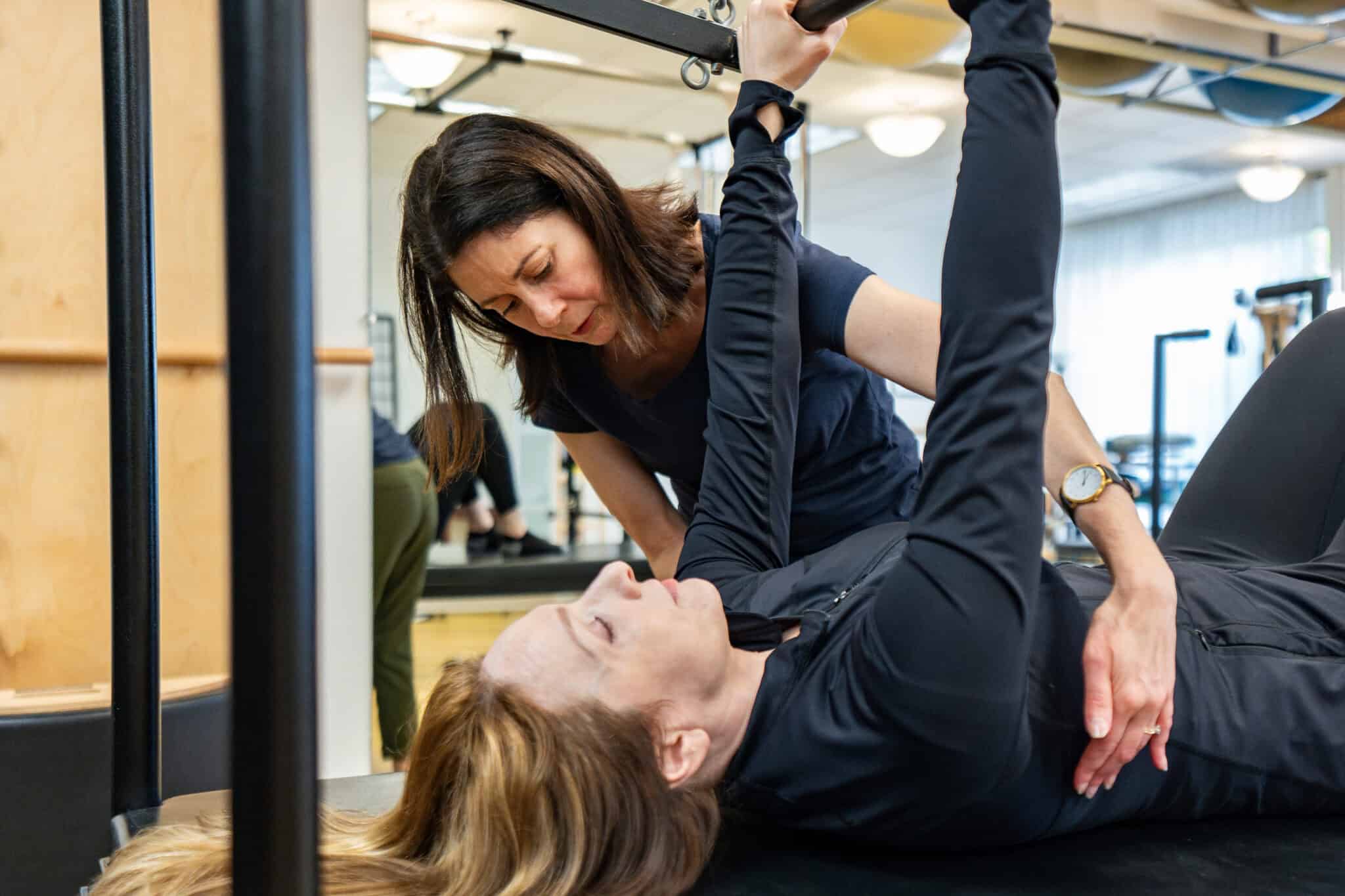
I’ve been teaching Pilates for more than 25 years. I’ve trained instructors on three continents. And I still get asked, almost weekly, some version of this question:
“Why the STOTT PILATES® Method? Isn’t Pilates just… Pilates?”
Fair question. Confusing answer, if you’ve spent any time Googling certifications.
Here’s the short version: when Melanie Byford-Young and I opened Pacific Northwest Pilates in 2001, we had to decide what kind of instructors we wanted to send into the world. Not just what exercises they’d know — but how they’d think. How they’d make decisions when a client walked in with a cranky shoulder, a brand-new hip replacement, or a body that didn’t match any textbook.
The STOTT PILATES® Method gave us that framework. Two and a half decades later, I still haven’t found a more thorough, intelligent, or honest system for training Pilates instructors. So that’s what we certify our students in as a Merrithew® Licensed Training Center. Here’s the real reasoning behind it.
What Is the STOTT PILATES® Method?
The STOTT PILATES® Method is a contemporary approach to the original exercise method pioneered by the late Joseph Pilates. Over more than three decades, Lindsay and Moira Merrithew — along with a team of physical therapists, sports medicine and fitness professionals — have refined the method by integrating modern principles of exercise science and rehabilitation, making it one of the safest and most effective methods available.
It’s not a rebranding. It’s a thoughtful evolution — one built around the idea that our understanding of the body has grown since the 1920s, and our teaching should grow with it.
Why I Trust This Method After 25+ Years of Teaching
I’ll be honest: I didn’t start out planning to build my career around the STOTT PILATES® Method. I found it the way a lot of people do — through an injury.
I was a professional dancer for 15 years. I performed with companies in Cleveland, Richmond, Oregon, and Portland. My body had been through it. When I got injured, a gifted surgeon pointed me toward the STOTT PILATES® Method, and that method is a big part of why I’m still moving well today.
That’s experience talking. But experience alone isn’t why we certify students in this method. The reasoning is structural.
1. It’s Built on Biomechanical Principles, Not Just Exercises
A lot of Pilates certifications teach you the what. The STOTT PILATES® Method teaches you the why.
Our students learn six biomechanical principles before they learn a single advanced exercise: Breathing, Pelvic Placement, Rib Cage Placement, Scapular Mobility & Stability, Head & Cervical Placement, and Lower Body Mobility & Stability. These principles become the lens through which they see every movement for the rest of their careers.
This matters because clients don’t arrive with textbook bodies. Let me give you an example from the principles themselves. Take Breathing — it isn’t just about inhaling and exhaling. It’s about understanding three-dimensional rib cage motion, how breath drives deep stabilizer activation, and how something as specific as a kyphotic posture requires a different exercise choice (Lateral Rib Cage Breathing Supine) than a flat-back posture would (Breathing Flexed Forward). A well-trained instructor can look at a real person, in real time, and figure out what that person actually needs. Without principles, you’re just running through choreography.
The Lower Body Mobility & Stability principle — which addresses the hip, knee, ankle, and foot as an interdependent kinetic chain — is another example of why this method has aged well. When new research on fascia and movement health emerges, it integrates naturally because the framework was built to accommodate it.
2. It’s Research-Informed and Continually Refined
One of the things that kept me with the STOTT PILATES® Method long-term is that the curriculum doesn’t stay frozen in time.
The method evolves as movement science evolves. It’s developed in collaboration with a team of physical therapists, sports medicine and fitness professionals, which means when meaningful research emerges on topics like fascia, motor control, intra-abdominal pressure, or pelvic stability, it gets integrated thoughtfully into the curriculum over time. I’ve been part of international curriculum training, and I can tell you: the standards are rigorous, and the updates are real.
For students, this means the certification they earn today won’t feel outdated in five years. The foundation holds, and the science around it keeps getting refined.
3. It Takes Rehabilitation Seriously
This is personal for me, because it’s personal for Melanie.
Melanie is a licensed physical therapist, and she has contributed to the development of the STOTT PILATES® Rehabilitation Program curriculum — the same program we now teach here in Portland. She helped shape it.
That matters because healthcare professionals who come through our doors aren’t getting a watered-down version of rehab-adjacent Pilates. They’re learning from someone who helped shape the program itself. And our non-clinical students benefit from this too: the Injuries & Special Populations coursework prepares them to work safely with real clients who have real histories.
Very few certifications integrate clinical reasoning this deeply. That alone would be enough reason to choose this method.
What Does STOTT PILATES® Certification Actually Involve?
STOTT PILATES® Certification involves substantial coursework covering Matwork, Reformer, Cadillac, Chair & Barrels, plus supervised teaching practice, observation hours, and written and practical exams — with total hours varying significantly by level and track.
It’s not a weekend course. It’s not something you knock out in a month to pad your resume. Our full Intensive Program students typically spend somewhere between 8 and 18 months training, depending on their schedule and which path they choose.
Here’s how the structure works:
The foundation is Level 1 (Essential and Intermediate), which establishes the biomechanical principles and core repertoire. From there, students can continue into Level 2 (Advanced) for more complex, multi-planar work with highly conditioned clients. Along the way, most students also complete Injuries & Special Populations, which is where the real clinical reasoning skills get built.
For healthcare professionals, there’s a separate STOTT PILATES® Rehabilitation Program track that integrates Pilates directly into clinical practice. This is where Melanie’s expertise really shines.
Why This Matters for Your Career, Not Just Your Education
Let me be blunt about something I wish more people talked about: not all Pilates certifications carry the same weight.
When you tell a studio owner, a physical therapist, or a prospective client that you’re a STOTT PILATES® Certified Instructor, they know what that means. The STOTT PILATES® Method is Merrithew’s premier Pilates program, with over 80,000 students trained in more than 100 countries. I’ve taught courses in the U.S., Canada, Spain, Japan, and Turkey — and the name travels.
For students building a career, this matters in practical ways:
- Studios actively recruit STOTT PILATES® Certified Instructors
- Healthcare referrals come more easily when your credentials are recognized
- You can confidently work with a broader range of clients, including complex cases
- Your training travels if you move, change cities, or expand your practice
- Continuing education opportunities are abundant and well-organized
I’ve watched graduates go on to open their own studios, build specialized practices in pre- and post-natal work, work with professional athletes, and integrate Pilates into chiropractic and PT clinics. The certification doesn’t just open doors — it gives them the skills to walk through those doors with confidence.
What Students Are Sometimes Surprised By
Here’s the part I’d tell anyone who’s considering this path: the certification will probably challenge you more than you expect.
Students sometimes come in thinking they’ll mostly be learning exercises. They leave having learned how to see. How to watch a person walk across a room and notice something. How to cue a movement three different ways because the first two didn’t land. How to adapt in real time when someone’s body doesn’t do what the textbook says it should.
That’s what separates a person who knows Pilates exercises from a Pilates instructor. And honestly, that’s the part that keeps the work interesting for a whole career. I’ve been doing this for 25+ years, and I’m still learning.
How Do You Know if the STOTT PILATES® Method Is Right for You?
STOTT PILATES® Certification is a strong fit for people who want comprehensive, principle-based training, value working with a wide range of clients, and are willing to commit to a rigorous, long-term education rather than a quick credential.
If you’re looking for a fast-track certification so you can teach a single Matwork class at your gym, this probably isn’t the right match. That’s not a judgment — it’s just honest.
But if you’re someone who wants to build a real career, work with complex clients, and feel genuinely confident in your teaching, this is the kind of training that will support you for decades. I say that as someone who’s lived it.
Frequently Asked Questions
How long does STOTT PILATES® Certification take?
Most students complete the full Intensive Program in 8 to 18 months, depending on schedule and chosen path. Individual courses can be completed in shorter timeframes.
Do I need a background in movement to start?
Not necessarily. We have students coming from dance, healthcare, fitness, and completely unrelated careers. What matters more is commitment and curiosity.
Is STOTT PILATES® Certification recognized internationally?
Yes. The STOTT PILATES® Method is taught in over 100 countries and is considered one of the leading contemporary Pilates methods worldwide.
What’s the difference between the STOTT PILATES® Method and classical Pilates?
Classical Pilates teaches the original repertoire as Joseph Pilates taught it. The STOTT PILATES® Method is a contemporary approach that integrates modern principles of exercise science and rehabilitation into that foundation.
Where to Go From Here
If this is the first time you’ve seriously considered Pilates as a career — or as an extension of the work you already do — the best next step is usually a conversation. Not a sales pitch. Just a conversation about where you are, what you’re drawn to, and whether this path fits.
You can book a free chat with our team, read more about our courses and programs, or learn more about our instructor trainers. If you know you’re ready to begin, our anatomy and Intensive course application is where that starts. Healthcare professionals should look at our Rehabilitation program application instead.
Twenty-five years in, I’m still convinced this is the best way to train an instructor. Not because it’s the easiest path. Because it’s the one that actually prepares you for the career you’re hoping to build. — Leslie Braverman
®/™ Trademark or registered trademark of Merrithew International Inc., used under license.
Pacific Northwest Pilates is a Merrithew® Licensed Training Center.