
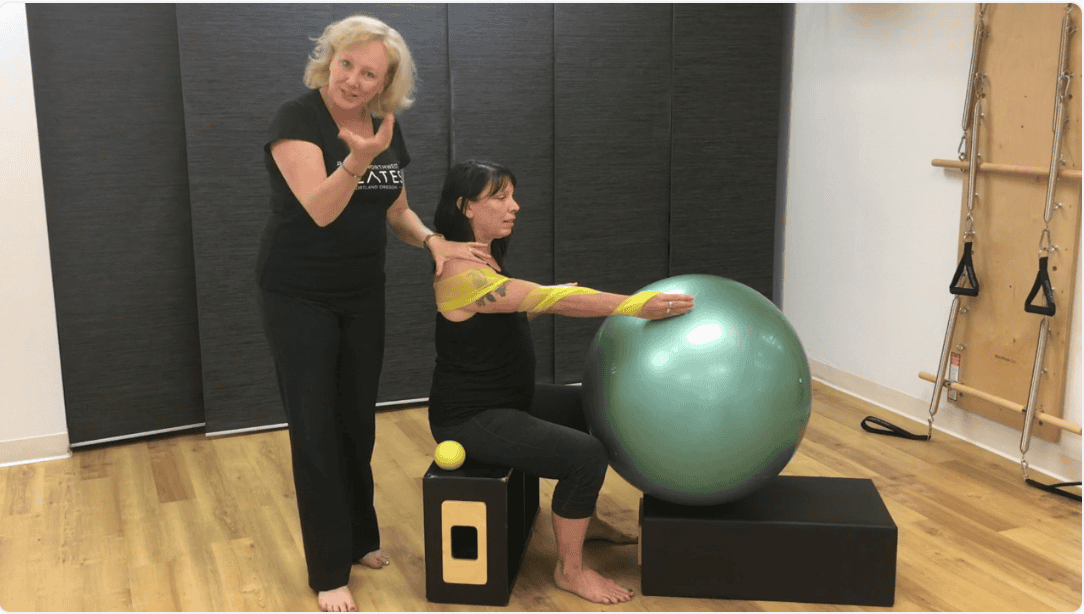
Shoulder discomfort is one of the most common issues seen in movement practice. Clients often report stiffness, irritation, weakness, or a persistent sense that their shoulder “just doesn’t feel right,” even when they are actively exercising.
In many cases, the first assumption is that the shoulder simply needs more strength or more stretching.
But a well-functioning shoulder is usually a well-organized shoulder.
The Shoulder Is a Coordinated System
The shoulder does not operate in isolation. Healthy mechanics depend on the coordinated relationship between the humerus, scapula, clavicle, and thorax. When timing, positioning, or load transfer are disrupted, the body compensates — sometimes long before a true structural injury exists.
This helps explain why clients can feel limited or uncomfortable despite appearing strong and flexible.
Strength without coordination does not guarantee stability.
Mobility without control does not guarantee function.
Common Shoulder Conditions Seen in Pilates Settings
Many clients seek Pilates specifically because of shoulder pain or prior injuries. Frequently encountered concerns include:
- rotator cuff irritation or tears
- shoulder impingement
- supraspinatus or biceps tendon irritation
- bursitis
- frozen shoulder (adhesive capsulitis)
- labral issues
- postural shoulder tension
- neural sensitivity or entrapment
These conditions are not always resolved by generic strengthening or stretching programs. Effective intervention often requires careful attention to alignment, sequencing, and joint organization.
Why Centering and Coordination Matter
When the humeral head is poorly positioned or scapular mechanics are inefficient, the shoulder must work harder to perform even simple tasks. Over time, this can contribute to irritation, guarding, and inconsistent exercise results.
Re-centering and improving coordination are often where meaningful change begins.
For Pilates instructors and movement educators, this means refining observational skills and understanding how shoulder mechanics relate to thoracic organization, muscular initiation, and motor control.
Pilates as a Tool for Smarter Shoulder Programming
Within the STOTT PILATES® methodology, principles of alignment and control provide a valuable framework for understanding shoulder function. Exercises become more than choreography — they become opportunities to observe movement quality, compensatory strategies, and load distribution.
This approach is especially relevant for:
- Pilates instructors
- movement professionals
- rehabilitation-informed educators
- students pursuing Pilates education
- clients seeking Pilates for shoulder pain
Deepening Shoulder Knowledge: In-Studio Course
For instructors and serious students looking to deepen their understanding of shoulder mechanics, Pacific Northwest Pilates is pleased to offer:
NEW & IMPROVED — IN STUDIO
STOTT PILATES® Optimization of the Shoulder Complex
📍 Pacific Northwest Pilates — Portland, Oregon
👩🏫 Taught by Melanie Byford-Young
🎓 1.2 Continuing Education Credits
💵 $840
🗓 April 18–19, 2026
This two-day lecture and practical course, developed by Merrithew, explores the anatomy and biomechanics of the shoulder girdle and applies STOTT PILATES® Principles as both a teaching and assessment tool. Participants examine movement sequencing, muscular initiation, joint stability, and practical programming strategies using mat work, the Reformer, and props.
A healthy shoulder is rarely accidental.
It is typically the result of good organization and coordination.
Contact our education coordinator to learn more at pnwpilates@gmail.com