
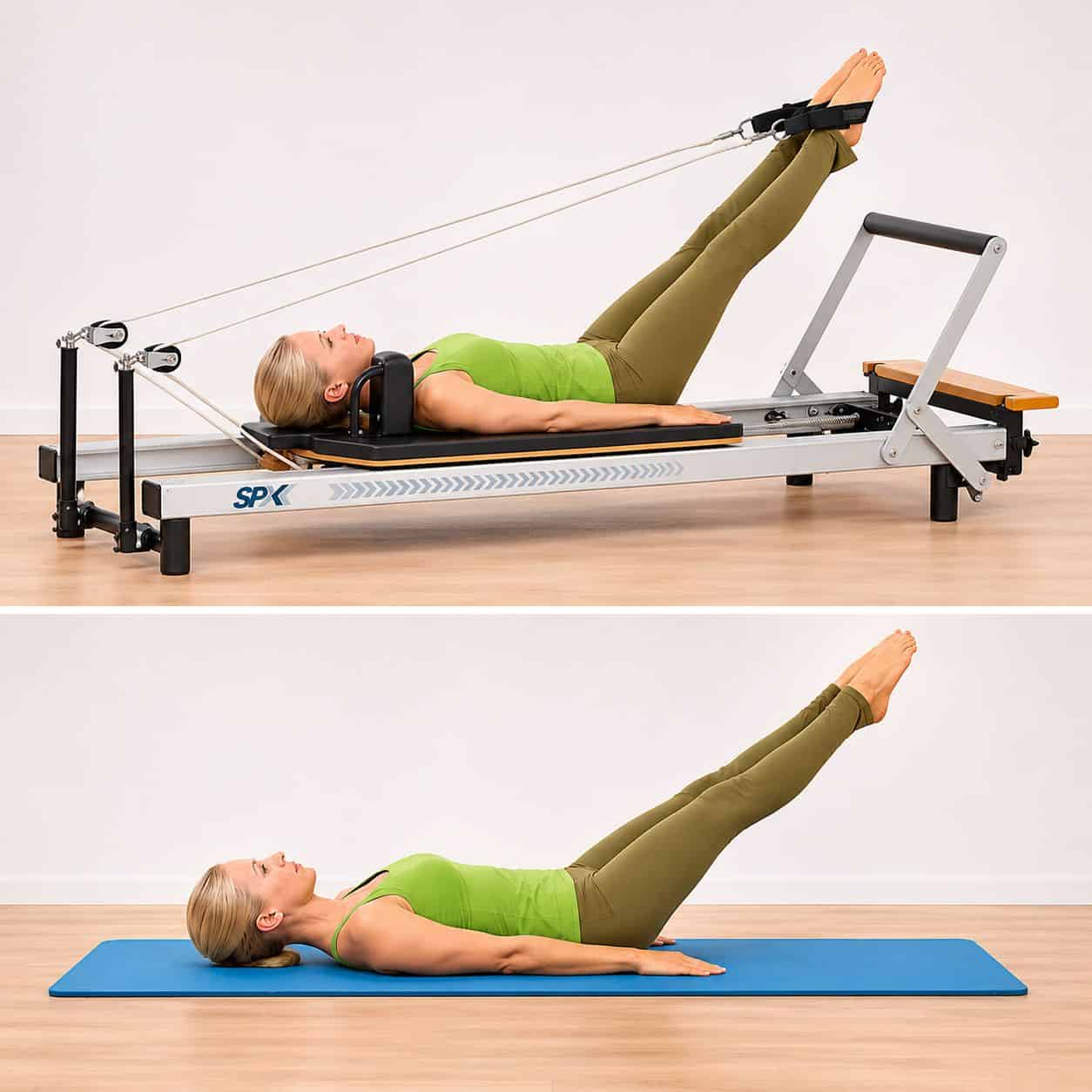
“Which is better, Reformer or mat?”
I hear this question at least once a week: during Starter Sessions, in conversations before and after class, and from friends who have just read something online and want a straight answer. After 25 years of teaching at Pacific Northwest Pilates in Portland, Oregon, here it is.
Neither one is better. They are two sides of the same method, and the right choice depends on your body, your history, your goals, and (honestly) what you will actually show up for.
In this article, I’ll walk you through what each one really is, how they differ, who tends to thrive on each, and how we help new clients decide. If you’d rather skip ahead and talk it through with a person, you can get started here or browse our group classes.
What Is the Difference Between Reformer and Mat Pilates?
Mat Pilates uses your body weight against gravity on the floor. Reformer Pilates uses a sliding carriage and springs that can assist or challenge you.
Joseph Pilates designed both the mat exercises and the equipment, and the history here is interesting. As I was taught it, the mat was the final goal. The equipment was there to get you there, supporting the body while it learned the patterns it would eventually perform on its own, on the floor.
Today, much of the Pilates world does the opposite and starts beginners on the mat. Why? I suspect it has more to do with practicality than with what’s best for the human body. Mats are inexpensive and you can fit a crowd in one room. Equipment costs more and takes up space.
Both share the same principles: breath, core control, alignment, and precise, efficient movement. What changes is the environment your body is working in.
Mat Pilates
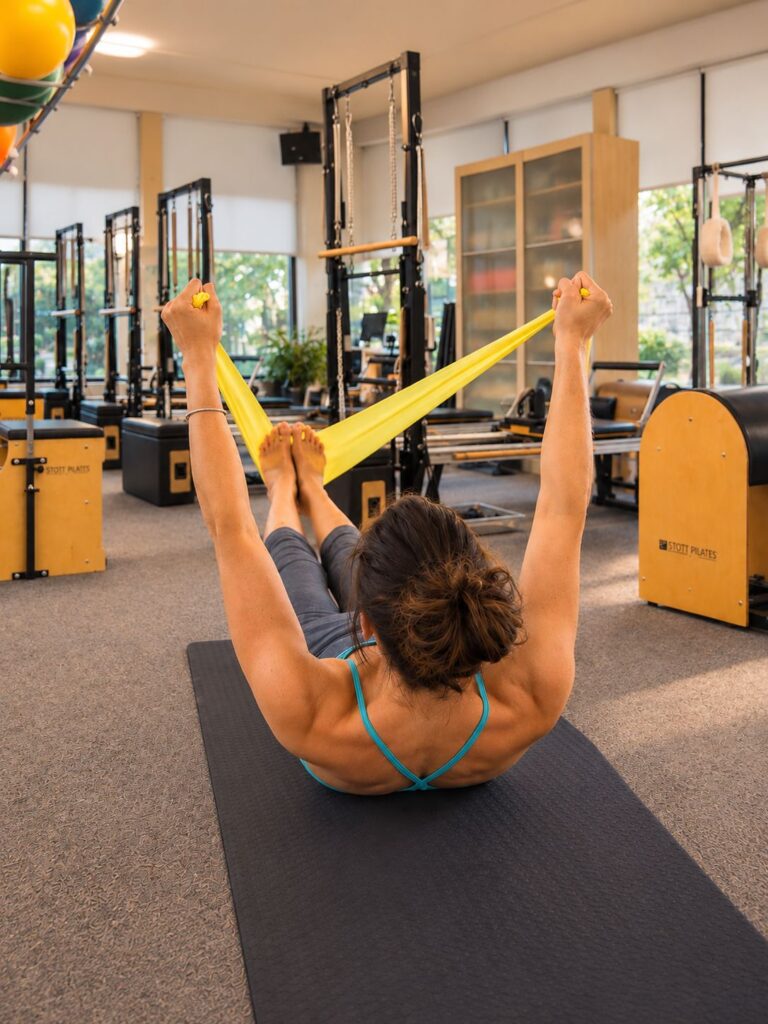
Mat Pilates (in the STOTT PILATES® repertoire, we call it Matwork) is performed on a padded mat. Sometimes we add small props, which you may recognize by their everyday names:
- Flex-Band® exerciser: a stretchy resistance band (you may know it as a TheraBand)
- Fitness Circle® resistance ring: the flexible ring you may know as a Pilates ring or Magic Circle
- Toning Balls™: small weighted balls that work like light hand weights
- Mini Stability Ball™: a small, soft inflatable exercise ball
These props add a little resistance or feedback, but the real work comes from your own body and gravity. There’s nothing beneath you but the floor, and nothing to help you except your own strength and control.
Reformer Pilates
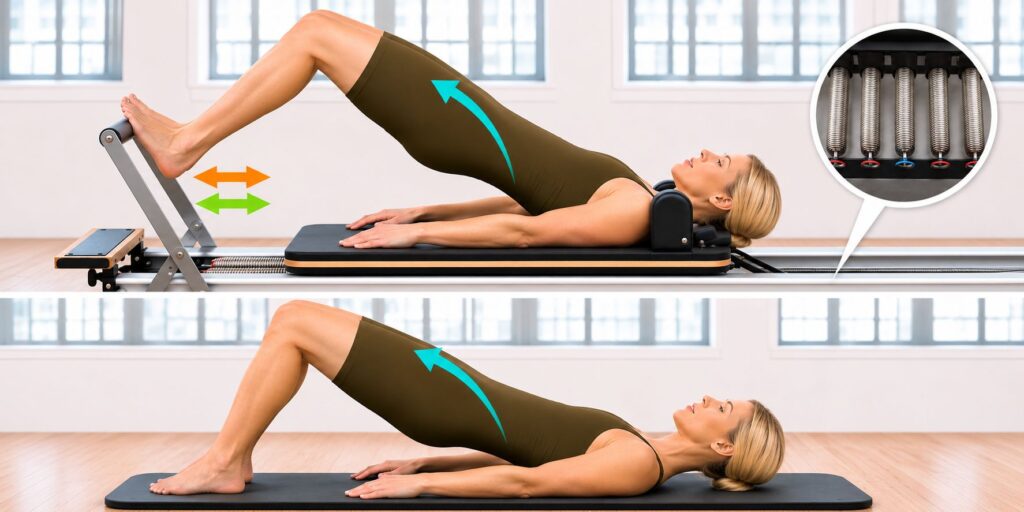
The Reformer is a bed-like frame with a padded carriage that glides back and forth on rails. Springs attach the carriage to the frame, and a footbar, straps, and shoulder blocks or pads give you places to push and pull. Here’s the clever part: those springs can make an exercise harder or easier. Heavier springs can add resistance for strength work, or provide support that helps you move through a range you can’t yet control on your own.
At our studio, Reformer classes also incorporate the Tower and V2 Max™ equipment, which adds even more ways to support or challenge the body.
Is Reformer Pilates Better Than Mat?
Neither is better. Reformer offers adjustable support and resistance; mat builds self-reliant control anywhere. The best choice fits your body.
Asking whether Reformer or mat is better is a bit like asking whether the Beatles or the Stones were better. People will argue about it all night, and the real answer is that each does something the other doesn’t.
The Reformer’s biggest advantage is adjustability. Because we can change the springs, we can meet almost any body where it is: someone recovering from a hip replacement and a former college athlete can work on the same machine, side by side, with completely different setups.
Mat Pilates’s biggest advantage is independence. It requires nothing but floor space, and it asks your body to organize itself without outside help. That makes it wonderfully portable and genuinely demanding.
Is Mat Pilates Harder Than Reformer for Beginners?
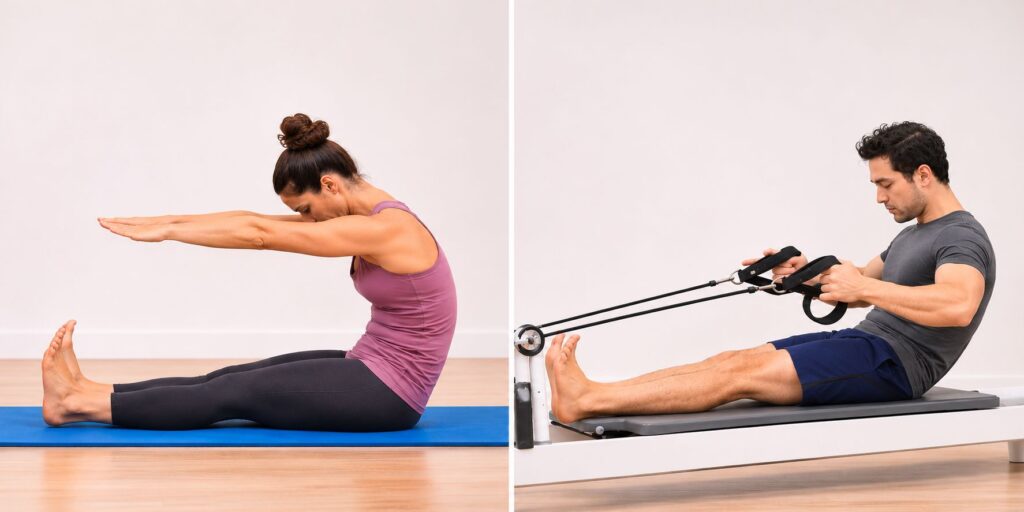
Often, yes. On the mat, there’s no spring to assist you, so a roll-up demands strength and control many beginners are still building.
This surprises nearly everyone. Really? The one without the machine is harder? Actually, yes.
Take the roll-up, where you peel your spine up off the floor one vertebra at a time. On the mat, you’re lifting the full weight of your upper body against gravity using abdominal strength alone. Many people, including very fit people, end up yanking themselves forward with momentum, which is exactly what we don’t want.
On Pilates equipment, a spring can assist that same movement, a bit like a steady hand helping you up. You get to feel what the exercise is supposed to feel like, which teaches your body the correct pattern. Over time we reduce the help, and your own strength takes over.
It isn’t only clients who notice this. Students in our teacher training program at Pacific Northwest Pilates Education often tell us the same thing: the equipment version of an exercise is frequently (not always) easier to learn and perform than its mat counterpart. If people training to teach Pilates find the mat harder, it’s no wonder beginners do.
There’s one more thing mat work asks of you: getting down to the floor and back up again. For some people that’s a barrier at first. But it’s also one of the most valuable skills you can build for staying independent, so we treat it as part of the work, not an obstacle to it.
Reformer vs Mat Pilates at a Glance
| Reformer Pilates | Mat Pilates | |
|---|---|---|
| Resistance | Adjustable springs; heavier isn’t always harder | Body weight and gravity |
| Support | Springs can assist, stabilize, or challenge, depending on the exercise | None beyond the floor |
| Stability challenge | Lighter springs let the carriage move freely, demanding more control | Constant, with no outside help |
| Feedback | Carriage, footbar, and straps give clear cues | Relies on body awareness |
| Learning curve | Often gentler for beginners | Often more challenging at first |
| Getting to the floor | Not required for most exercises | Required |
| Where you can do it | Studio, or at home with equipment | Almost anywhere |
| Best for | Injury history, joint pain, deconditioning, extra body weight, adjustable strength work | Travel, home practice, self-reliant control |
What Makes STOTT PILATES® Equipment Different?
Merrithew® builds STOTT PILATES® equipment to professional standards, with precise springs, smooth carriages, and options for multi-plane movement.
I’ll admit a bias here: after 25 years of teaching on it, I think Merrithew equipment is some of the best in the industry. You’ll see our studio’s equipment in the photos throughout this article, and here’s what stands out to me:
- Reliable springs. When an instructor changes your spring setting, you feel a clear, predictable difference. That matters when we’re fine-tuning support around a sensitive joint.
- Multi-plane movement. Our V2 Max Plus™ Reformers add a vertical frame with retractable ropes and travelling pulleys, so we can change the angle of resistance. That opens up rotation, standing, and lunging work that mirrors real life, from a golf swing to a steep trail.
- A comfortable working height. The carriage on our V2 Max Plus™ Reformers sits 17.25 inches off the floor, about the height of a typical chair seat. Merrithew’s Rehab models raise it even higher for easier on and off.
- Built for real bodies. The V2 Max Plus™ Reformer supports up to 425 pounds, and length extensions are available for clients taller than 6’4″ or with longer torsos.
- Props that travel. The Flex-Band® exerciser lets you echo Reformer-style resistance in a hotel room, and the Fitness Circle® resistance ring adds feedback and challenge to Matwork.
Who Is Reformer Pilates Best For?
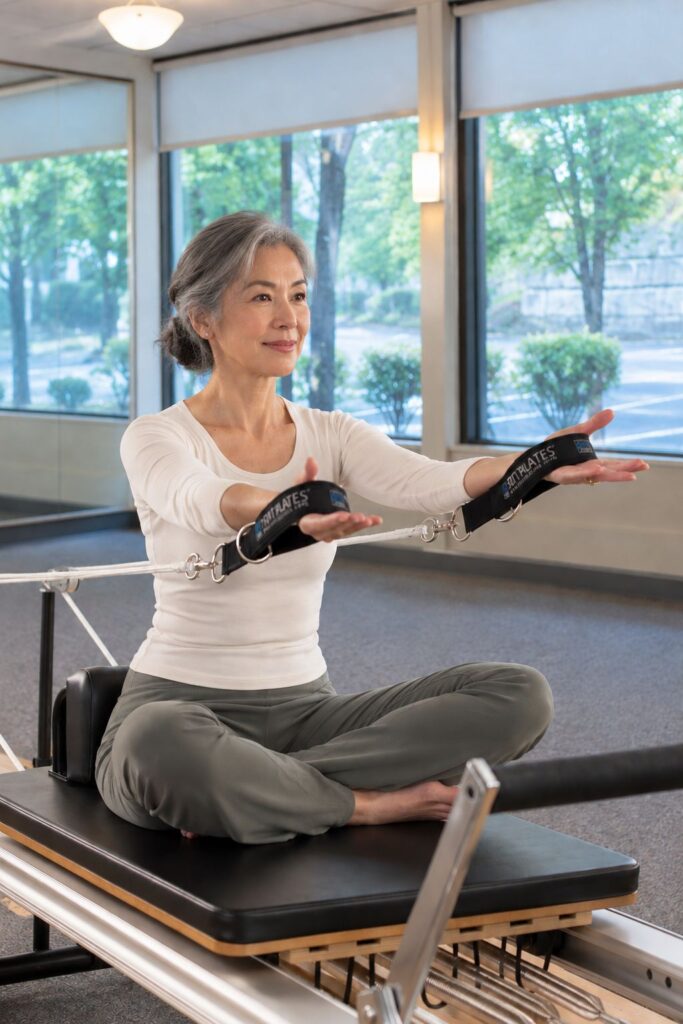
Reformer suits people with pain, joint issues, injury history, or deconditioning, and anyone wanting adjustable, full-body strength work.
In my experience, people tend to flourish on the Reformer if they:
- Have a history of injury, surgery, or persistent pain. The springs let us work around sensitive areas while still building strength.
- Have joint pain. Supported positions and adjustable springs reduce the load on knees, hips, and wrists, so you can build strength without aggravating them.
- Are deconditioned or returning after time away. The springs can assist you, so you start where your body is today instead of where you think it “should” be.
- Are carrying extra weight. Many Reformer exercises are done lying down or seated, which takes body weight off the joints while you build strength.
- Have recently finished physical therapy. Many clients feel better after PT but aren’t sure how to keep progressing. The Reformer is an excellent bridge between rehabilitation and long-term strength.
- Find getting down to the floor difficult right now. At roughly chair-seat height, getting onto and off of a Reformer is far more manageable than getting down to a mat.
- Want sport-specific strength. Golfers, tennis players, and hikers love the rotational and standing work.
- Learn best with feedback. The equipment tells you immediately when you’ve lost alignment, which is incredibly useful.
One longtime client, Beth Howard, put it well: “I have practiced Pilates for many years but learned much better technique at your studio. Recovering from two shoulder replacements and a broken leg has been greatly enhanced by the classes.”
For clients managing chronic pain or movement limitations, our Therapeutic Reformer classes are capped at six people and include modifications throughout class.
Who Is Mat Pilates Best For?
Mat suits people who travel, want a practice they can do anywhere, prefer body-weight work, or want to build deep control without equipment.
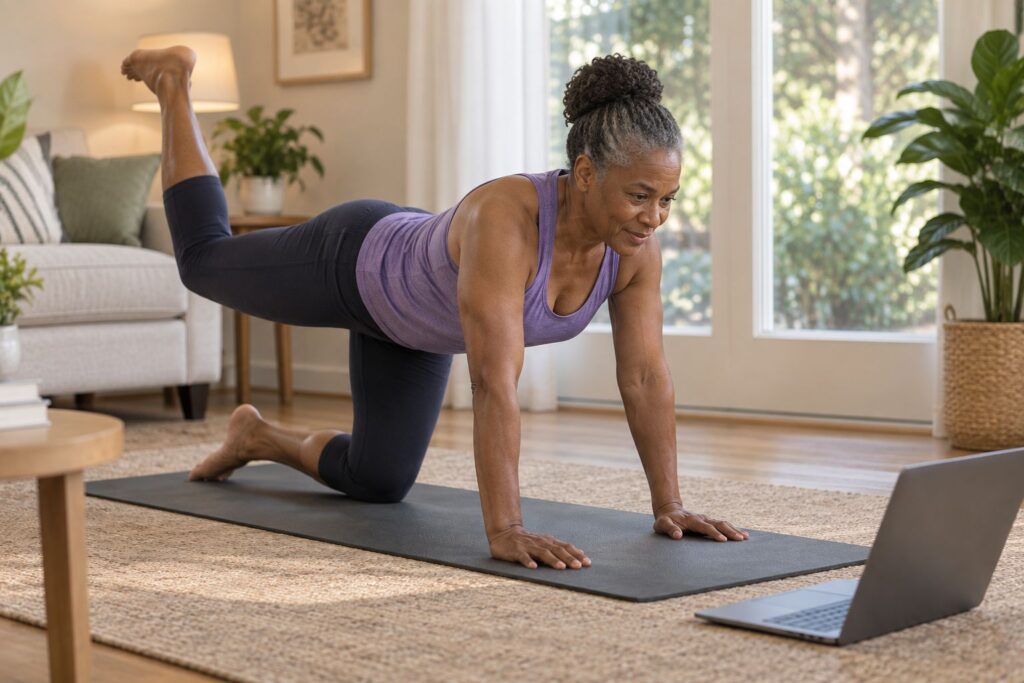
Mat Pilates is a wonderful fit if you:
- Travel often or split time between homes. A hotel room floor works just fine.
- Want a home practice that keeps you consistent between studio visits.
- Already have a solid foundation and want to test and refine your control.
- Enjoy the challenge of supporting yourself with no outside help.
While most of our programming today is equipment-based, we still offer a small selection of live online mat classes over Zoom, which travelers especially appreciate. That includes an online Therapeutic Pilates mat class focused on neck, shoulder, and upper-back tension, which is a lifesaver for anyone who spends long days at a desk or on airplanes.
Can You Do Both Reformer and Mat Pilates?
Yes, and many clients do. Reformer builds strength with support; mat tests whether that control holds up when the springs are gone.
Here’s how I like to explain it to the professors in our client community: the Reformer is an open-book exam, and the mat is a closed-book exam. The Reformer gives you resources to lean on while you learn the material. The mat asks, “Okay, did it actually stick?” Which, if you think about it, is pretty close to the order Joseph Pilates had in mind.
Both are valuable. Clients who combine them often notice that their Reformer work gets more precise and their mat work gets stronger, because each one fills in what the other leaves out. Cool, right?
How Do You Choose Between Reformer and Mat Pilates?
Consider your health history, goals, schedule, and travel. A one-on-one assessment with an experienced instructor is the clearest way to decide.
If you’re weighing your options, ask yourself these five questions:
- What’s my body’s history? Past injuries, surgeries, joint replacements, or ongoing pain usually point toward starting on equipment, where we can adjust support.
- How comfortable am I getting down to the floor and back up? If that feels uncertain right now, the Reformer is a great place to start, and we can build toward floor work over time.
- Where will I practice? If you’re traveling half the year, a mat practice (or online classes) keeps you consistent.
- What do I want my body to do? Better balance on the trail? A smoother golf swing? Less stiffness when you get out of the car? Your goals shape the program.
- What will I actually enjoy? The best exercise is the one you’ll keep doing. As client Lynda Camph told us, “I’ve always hated exercise and P.E., but I love all of you, your amazing instructors and classes.”
How Does Pacific Northwest Pilates Help You Decide?
Every new client starts with a Starter Session, where an instructor reviews your history, assesses movement, and recommends next steps.
We don’t believe in guessing. In your Starter Session, an experienced instructor learns about your health history and goals, looks at your posture and movement patterns, introduces the principles of the STOTT PILATES® Method, and helps you figure out what makes sense for you.
From there, clients typically move into one of several options:
- Private sessions in Fundamental, Specialized, or Therapeutic Pilates, tailored to your body and goals.
- The Quickstart Series, a four-week, twice-weekly small-group program that teaches more than 30 beginner Reformer exercises, so you walk into regular classes feeling confident.
- In-studio Reformer classes, capped at six participants, with nearly 20 classes a week across levels.
- Therapeutic Reformer classes for those managing pain or movement limitations.
- Live online classes, including mat, therapeutic mat, yoga, and Reformer for experienced clients with equipment at home.
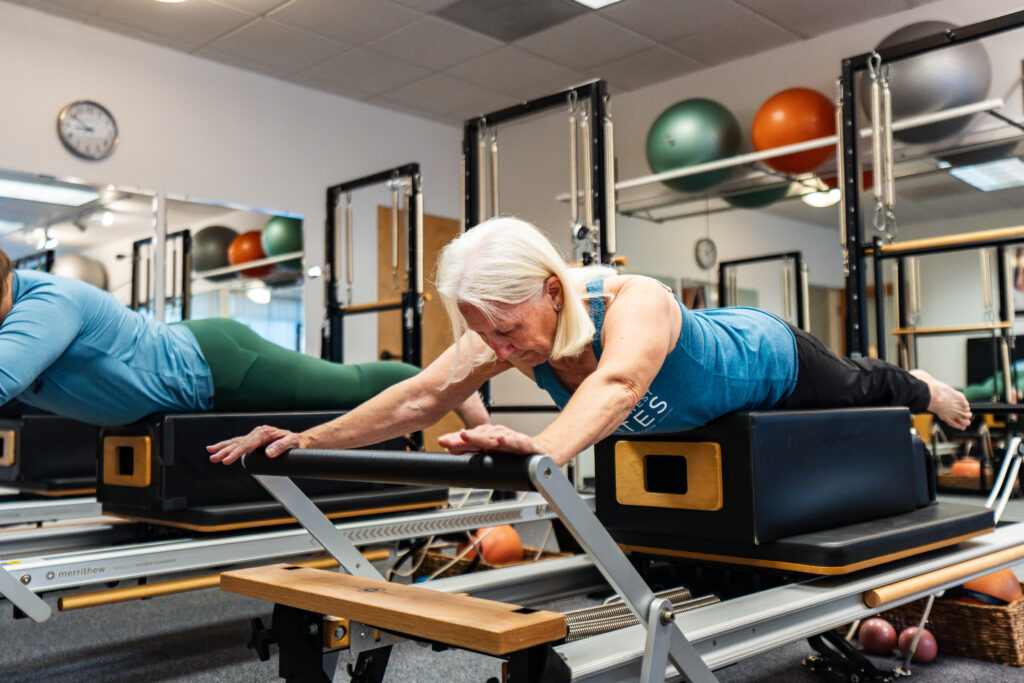
In the interest of full disclosure: we don’t offer many mat-based classes anymore. After COVID, we had to become more economical with our space, and we leaned into the equipment. Honestly, it’s been a natural fit. For most of our clients, the Reformer simply makes more sense. They don’t have to get down on the floor, which is a wonderful skill to work toward but often isn’t realistic at the beginning. On the equipment, we can start where your body is today and build from there.
Frequently Asked Questions About Reformer vs Mat Pilates
Is Reformer Pilates safe if I have back pain or a past injury?
For many people, yes, when it’s taught by a qualified instructor who adjusts the springs and exercises to your body. That’s why we begin with an assessment. If you’re under a doctor’s or physical therapist’s care, check with them as well; we’re happy to coordinate when appropriate.
Do I need experience before taking a Reformer class?
No, but we recommend learning the basics first. Our Quickstart Series or a few private sessions will teach you how the equipment works, so group classes feel comfortable from day one.
How often should I do Pilates to see results?
Many of our clients practice two to three times a week. Consistency matters more than intensity. Regular practice builds strength, balance, and body awareness steadily over time.
Can I do Reformer Pilates online?
Yes, if you have a Reformer at home. Our live online Reformer classes are designed for intermediate and experienced clients who already know the equipment.
Is mat Pilates enough on its own?
It can be a complete, effective practice. Many people still benefit from equipment work, especially when managing an injury or building strength they can’t yet access on the floor.
The Bottom Line
Reformer and mat Pilates aren’t rivals. They’re teammates. The Reformer offers support and adjustable resistance that can meet almost any body where it is. The mat builds self-reliant strength you can take anywhere. And most people, over time, benefit from both.
The real question isn’t “Which is better?” It’s “Which is better for me, right now?” That’s a question we love helping people answer.
If you’re curious, start with a conversation. Book a free chat with our team, or schedule your Starter Session and let’s figure it out together.
Want to Read More?
- Beginner’s Guide to Your First Pilates Class in Portland: What to Expect
- Reformer Pilates for Beginners: Your 4-Week Starting Point
- Pilates for Low Back Pain: Why the Right Exercise Depends on the Person
Pacific Northwest Pilates is a STOTT PILATES® Academy Partner.