
“What exercise should I do for my back?”
We hear this question constantly at our Portland, Oregon Pilates studio. And it makes sense — when your back hurts, you want a clear answer. A quick search will hand you plenty of lists claiming to reveal the “best exercises for low back pain.”
Here’s the problem: low back pain isn’t one single thing with one single fix.
Two people can feel pain in exactly the same spot — even look like they’re standing the same way — and need completely different approaches to movement. So the more useful question isn’t “What’s the best exercise for back pain?” It’s “What kind of movement does this particular person need?”
That question is the foundation of how we teach Pilates at Pacific Northwest Pilates.
Why Isn’t Low Back Pain Just One Problem?
Low back pain has many possible contributing factors, so the same symptom in two people doesn’t always mean the same thing is happening in their bodies.
Our understanding of back pain has evolved a lot over the past couple of decades. Researchers and clinicians increasingly recognize that “nonspecific low back pain” — the technical term for the majority of back pain cases — isn’t a single, uniform condition. It shows up differently depending on someone’s history, their movement habits, their stress levels, and even how their nervous system has learned to interpret certain positions or loads.
We’re not going to turn this into a medical lecture. You don’t need a catalog of diagnoses. The client takeaway is simple: back pain is individual, so exercise programming should be individual too.
What Does a Pilates Instructor Actually Assess?
A skilled Pilates instructor evaluates how you move, not what’s medically causing your pain — that distinction matters and it’s where healthcare providers and movement professionals each play their role.
At Pacific Northwest Pilates, a movement assessment looks at things like:
- How you organize your body in different positions
- Where your movement is easy, and where it’s restricted
- How well you control the range of motion you already have
- How your body responds to resistance and load
- Where you might be creating unnecessary muscular tension
- Whether added support changes how you move
- How your symptoms shift with different positions, exercises, and cues
Diagnosing the medical cause of pain belongs to your physician, physical therapist, or another qualified healthcare provider. Our job as Pilates instructors is to understand movement well enough to make thoughtful, individualized exercise choices — and to know when to refer a client back to their healthcare team.
Can Two People With the Same Posture Need Completely Different Exercises?
Yes — two people can look nearly identical in a standing posture and still need opposite approaches, because the muscular strategy underneath that posture is often completely different.
Take hyperlordosis, a common way of describing an increased curve through the lower back. Two clients might walk in with what looks like the exact same curve.
Client A: Holding On Tight
Client A may be holding that position with a lot of muscular tension and compression. Their body is already working overtime just to stay there.
Client B: Not Enough Support
Client B may have plenty of available movement but very little muscular support or control. Rather than gripping, they tend to sink or “hang” into the position.
Visually, they can look remarkably alike. But if you hand both of them the same instruction — “just strengthen your core” — or the exact same Pilates exercise, you’re likely helping one of them and doing very little (or even working against) the other.
Why Isn’t “Strengthen Your Core” Always the Right Advice?
Strength and stability aren’t the same thing, so building more strength doesn’t automatically solve a control or coordination problem in the low back.
“Strengthen your core” has become the default prescription for back pain — but it’s not that simple. Someone can already be quite strong and still be using inefficient, effortful strategies to move. Someone who’s already bracing and gripping through their midsection may not benefit from being told to work harder. They need to learn to release, not clench.
Someone else may genuinely need to build more muscular support and control from a body that hasn’t developed it yet.
So instead of asking only “How can we make this stronger?” — a thoughtful instructor is also asking “What response are we actually trying to create in this person’s body?”
How Does Pilates Equipment Help With Individualized Programming?
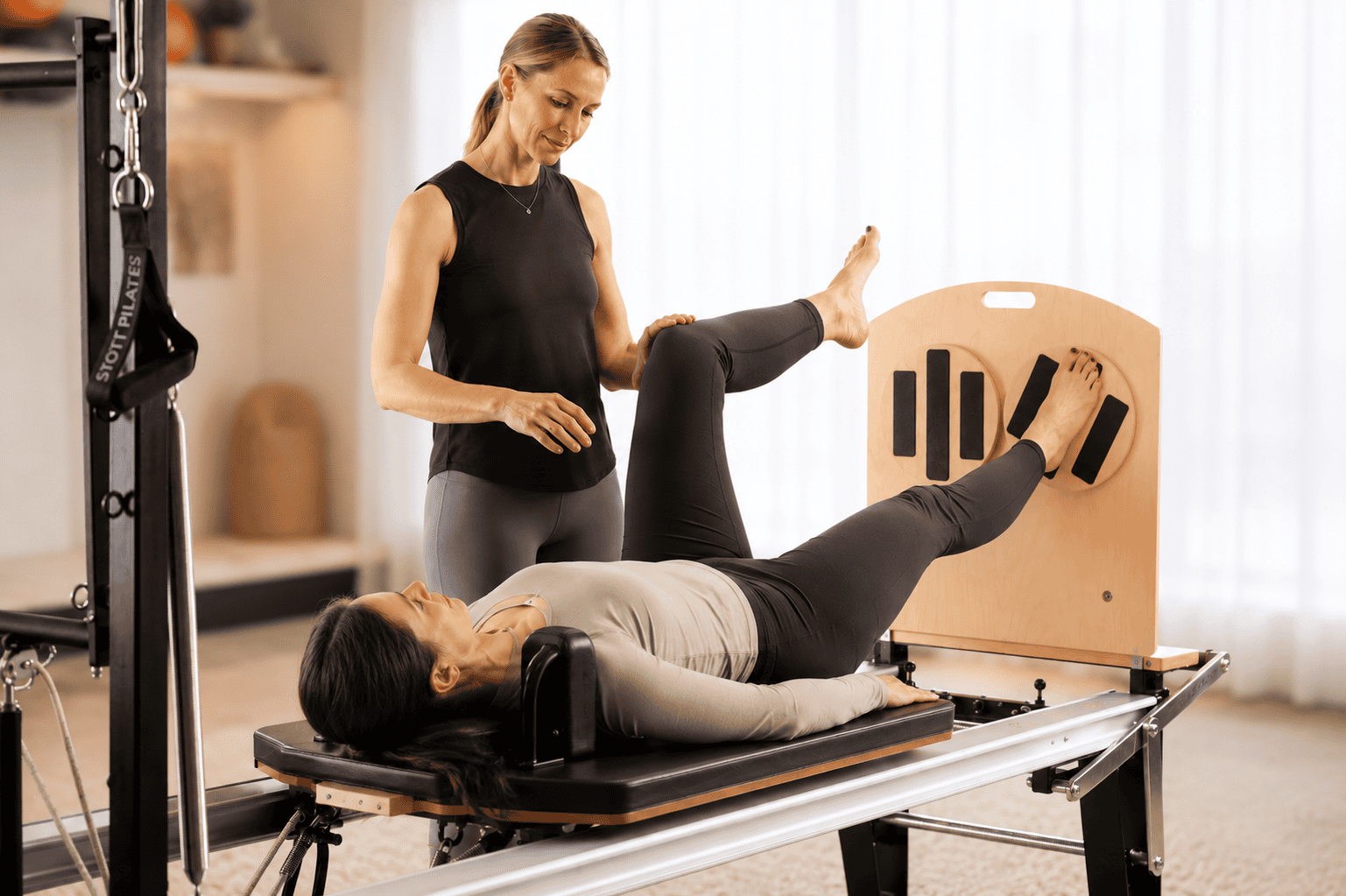
Pilates equipment lets an instructor fine-tune resistance, support, range, and tempo for each client, which is exactly what individualized back pain programming requires.
This is where Pilates has a real advantage. With the right equipment and exercise selection, an instructor can adjust:
- Resistance (spring tension)
- Support (props, positioning, equipment)
- Range of motion
- Body position
- Tempo
- Stability demands
- Exercise choice
- Verbal and tactile cues
A heavier spring isn’t automatically “harder,” and a lighter spring isn’t automatically “easier.” Sometimes more support allows someone to move better and find a healthier pattern. Sometimes less resistance asks a client to create more of their own control, rather than relying on the equipment to do the work.
If you’ve ever wondered why your instructor swapped your spring setting or changed your starting position mid-session, this is why. Those small decisions, made week after week, are the individualized part of your Pilates practice.
So, Is Pilates Good for Low Back Pain?
For many people, appropriately selected Pilates exercise can be a valuable part of staying active, rebuilding capacity, and returning to the activities they care about — but the exercises themselves need to fit the individual.
For many people dealing with low back pain, thoughtfully chosen exercise is an important part of staying active, building capacity, and getting back to the activities that matter — travel, gardening, golf, keeping up with grandkids. Pilates offers a wide range of tools to develop strength, mobility, and movement control while adapting each exercise to the person in front of the instructor.
But “Pilates for back pain” shouldn’t mean handing everyone with back pain the same collection of exercises off a list. The method only works as well as the individualization behind it.
Rose King, who has practiced with us for two years, put it simply:
“Pacific Northwest Pilates helped me heal a lower back problem that I had for more than 10 years. I am so grateful for the expert instructors and terrific classes.”
Ten years is a long time to carry a problem. It’s also a good reminder that the right approach, applied consistently, can make a real difference — even after a decade of frustration.
When Should You See a Doctor Instead of Starting Pilates?
New, severe, worsening, or unexplained back symptoms should be evaluated by a healthcare provider before starting any new exercise program.
If your symptoms are new, severe, getting worse, or you’re not sure what’s causing them, talk to your physician, physical therapist, or another appropriate healthcare provider first. Pilates instructors can work alongside your healthcare team when needed, while staying focused on our own area of expertise: movement and exercise.
The Takeaway
There isn’t one “best” Pilates exercise for low back pain, because there isn’t one type of person with low back pain.
Good Pilates instruction looks at the person in front of them — how they move, how they respond to load, where they need more support, where they need less effort, and how those needs shift over time. That’s what individualized movement programming actually looks like, and it’s the approach we’ve built Pacific Northwest Pilates around since 2001.
If you’re living with back pain, or you’re returning to exercise after an injury and not sure where to start, we’d love to help you figure out what your body actually needs — not a generic list, but a plan built around you.
Frequently Asked Questions
Is Pilates Safe for Low Back Pain?
For most people, yes — when the exercises are selected and adapted for their specific body and history. That’s why an initial movement assessment matters more than any generic exercise list.
What’s the Difference Between Pilates and Physical Therapy for Back Pain?
Physical therapy typically diagnoses and treats a specific injury or condition. Pilates picks up where PT often leaves off, helping people rebuild strength, control, and confidence in their movement over the long term.
How Long Does It Take to Feel Relief From Back Pain With Pilates?
This varies widely by person. Some clients notice easier movement within a few sessions; others, like Rose King, describe changes after consistent, longer-term practice.