
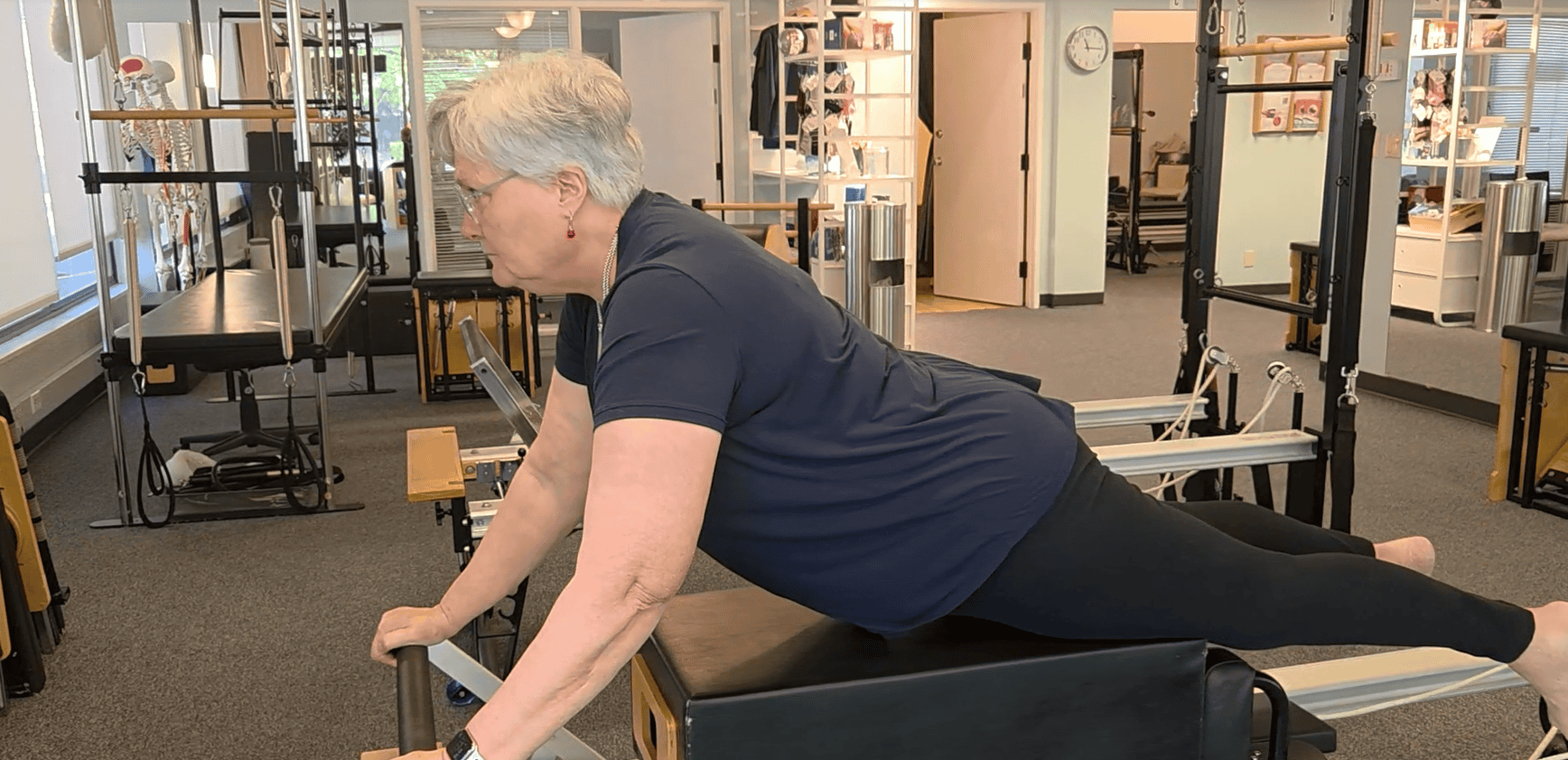
Angie Moore’s low back started locking up on her in her 60s. Bending over hurt. Rolling over in bed hurt. Sweeping the kitchen floor hurt, which surprised her, since sweeping doesn’t take much force at all — it’s the twisting.
Her instinct was to protect the area by keeping it as still as possible. It felt logical. It also made everything worse.
If you searched for Pilates for seniors, age is probably part of why you’re here — and that’s a fair place to start. But what actually changed for Angie had less to do with turning 60 than with a pattern her body had learned over years: guard the sore spot, keep it still, don’t test it. That kind of protective bracing can show up at any age. It just tends to accumulate the longer it goes unaddressed.
The short answer: Pilates for people managing pain, old injuries, or years of guarding a part of the body that’s stopped cooperating — at any age — is one of the most effective ways to rebuild strength, mobility, and confidence, when it’s taught by properly trained instructors. Angie’s experience at Pacific Northwest Pilates, a Portland, Oregon studio, is one example of what that process actually looks like, week by week.
Is Pilates Safe for Older Adults With Back Pain or Old Injuries?
Angie didn’t walk into a Pilates studio first. Her back pain had progressed to spasms severe enough to interfere with walking, and she wanted to be careful about what she tried next. She started with private sessions with a yoga teacher who was also a physical therapist, hoping that combination would keep her safe.
Yes — when it’s taught by instructors trained to assess each client’s history and adapt exercises to their specific pain, not a generic routine.
It helped, but it wasn’t often enough to make a real dent. She’d heard about Pacific Northwest Pilates and lived just down the hill, so she decided to give it a try — starting with private sessions before moving into small group classes.
What stood out to her early on was the attention to form, and something simple that became a running theme in every class: the instructors ask what’s hurting that day. (If low back pain sounds familiar, we’ve written about why the right exercise depends on the person.) Sometimes a class shifts around the answer.
When walking up stairs was still giving Angie trouble, her instructor suggested a session with studio co-founder Melanie Byford-Young. Melanie’s assessment reframed the problem — the issue wasn’t actually her low back, it was her mid-back, something that lined up with an area her earlier imaging had flagged. Hands-on work to help that vertebra move, combined with ongoing class work, made a real difference.
What Does Pilates for Active Older Adults Actually Look Like Week to Week?
Small classes — capped at six people — with instructors who check in on what hurts, adjust exercises in real time, and build strength gradually rather than pushing a fixed routine.
At Pacific Northwest Pilates, group Reformer classes are limited to six participants specifically so instructors can give individual cueing and corrections without losing the energy of a group setting. For clients working through an injury or a long-standing pain pattern, that ratio matters. There’s room for an instructor to notice what’s happening in someone’s body and adjust before a small issue becomes a setback.
Angie’s full story — including what it took to go from feeling “disabled,” in her words, to walking, gardening, and traveling without the fear she used to carry — is told in a short client video below.
How Long Does It Take to See Results From Pilates?
Most clients notice real change over six to eight weeks of consistent practice — and progress tends to arrive gradually, as more good days than bad, rather than one dramatic turning point.
Angie set herself a simple test when she started: three classes a week, for six weeks, to see if it made a difference. It did. But she’s clear that the improvement wasn’t a straight line.
“You get more and more good days between the bad days,” she said, describing the shift from being in near-constant pain to noticing, one morning at a time, that a particular movement didn’t hurt anymore. Almost seven years later, she still finds small improvements — most recently, a cueing change around opening the front of her hips that made a noticeable difference in how far she can comfortably walk.
What Surprises People Most When They Start Pilates?
Many clients come in trying to protect an area by keeping it still — and are surprised to learn the opposite is true: the spine is meant to move, safely and progressively, not be locked down.
For Angie, the biggest surprise wasn’t a specific exercise. It was a mindset shift.
“I could — I should — I could and should move my spine,” she said. Exercises involving twisting and spinal rotation had been exactly what she’d avoided for years, convinced that stillness was protection. Learning to move through those patterns, with guidance, turned out to be the opposite of what she expected.
“It wasn’t just that you can move it, it was that you should move it, and you’re better off if you do. That was the surprise.”
Do You Have to Be Flexible or Already Fit to Start Pilates as an Older Adult?
No. Pilates at PNWP is built to meet people where they are, and instructors adjust exercises for everything from arthritic hands to recent joint replacements — no prior fitness level required.
Angie describes her classmates as a genuine source of motivation — not because everyone looks the same, but because they don’t. Some are working through arthritic hands or a stiff shoulder. Others are, in her words, “pretty doggone strong.” One classmate recently celebrated her 88th birthday.
New clients often worry they’ll slow the class down or take up too much of the instructor’s time. Angie’s answer to that: “We’ve all been there. We’ve all been beginners. Don’t worry about it.” With six people per class, there’s enough instructor attention to go around.
Can Pilates Support Recovery After Surgery, Like a Knee Replacement?
Every recovery is different and should be guided by a client’s surgeon and physical therapy team — but many clients continue Pilates as part of that broader care plan, adjusting exercises as they heal.
That gap — feeling better once treatment ends but still not sure how to keep progressing on your own — is common enough that we’ve written about it separately.
Angie has been through two total knee replacements and returned to Pilates within a couple of months of each. She credits the strength and body awareness she’d built over years of practice with helping that return go smoothly, and says she’s learned what to do — and what not to do — after activity that pushes her further than usual.
Her experience isn’t a guarantee about anyone else’s recovery timeline, and it isn’t a substitute for medical guidance. It’s one client’s account of how an existing Pilates practice fit into her recovery alongside her medical care.
Common Questions About Pilates for Seniors
Is it ever too late to start Pilates?
No specific age rules someone out. Instructors adapt exercises to each person’s current mobility, pain, and goals — whether that’s a first class at 55 or a return to movement at 80.
Is Pilates the same as physical therapy?
No. Physical therapy treats a specific diagnosis under medical supervision. Pilates is a movement practice that many clients continue after PT ends, to keep building strength and confidence on their own.
How many times a week should older adults do Pilates?
Many clients start with two to three classes a week for the first six to eight weeks to build a foundation, then adjust frequency based on how their body responds.
Is small-group Pilates better than a large class for someone with an injury?
For clients managing pain or a movement limitation, smaller classes allow more individualized cueing. Pacific Northwest Pilates caps group Reformer classes at six participants for this reason.
What to Expect at a First Session
Every new client at Pacific Northwest Pilates begins with a Starter Session. It’s a chance for an instructor to understand a client’s history and goals, assess posture and movement patterns, and recommend the right next step — whether that’s private sessions, a small group class, or the studio’s Quickstart Series for people new to the Reformer.
For someone like Angie, arriving with years of guarding a painful back, that first conversation is often where the shift starts: not with a workout, but with someone asking what’s actually going on in the body before deciding what to do about it.
Angie still isn’t sure what would make her stop. She’s not chasing a finish line — she’s paying attention to how she’s doing right now, and adjusting from there. That’s turned out to be enough.
Want to Read More?
- Beginner’s Guide to Your First Pilates Class in Portland: What to Expect — a walk-through for anyone who hasn’t set foot in a Pilates studio yet
- Quickstart Series — a four-week introduction to the Reformer for people brand-new to Pilates
- Therapeutic Pilates Group Classes — small-group classes (max six people) for clients managing pain or recovering from injury