
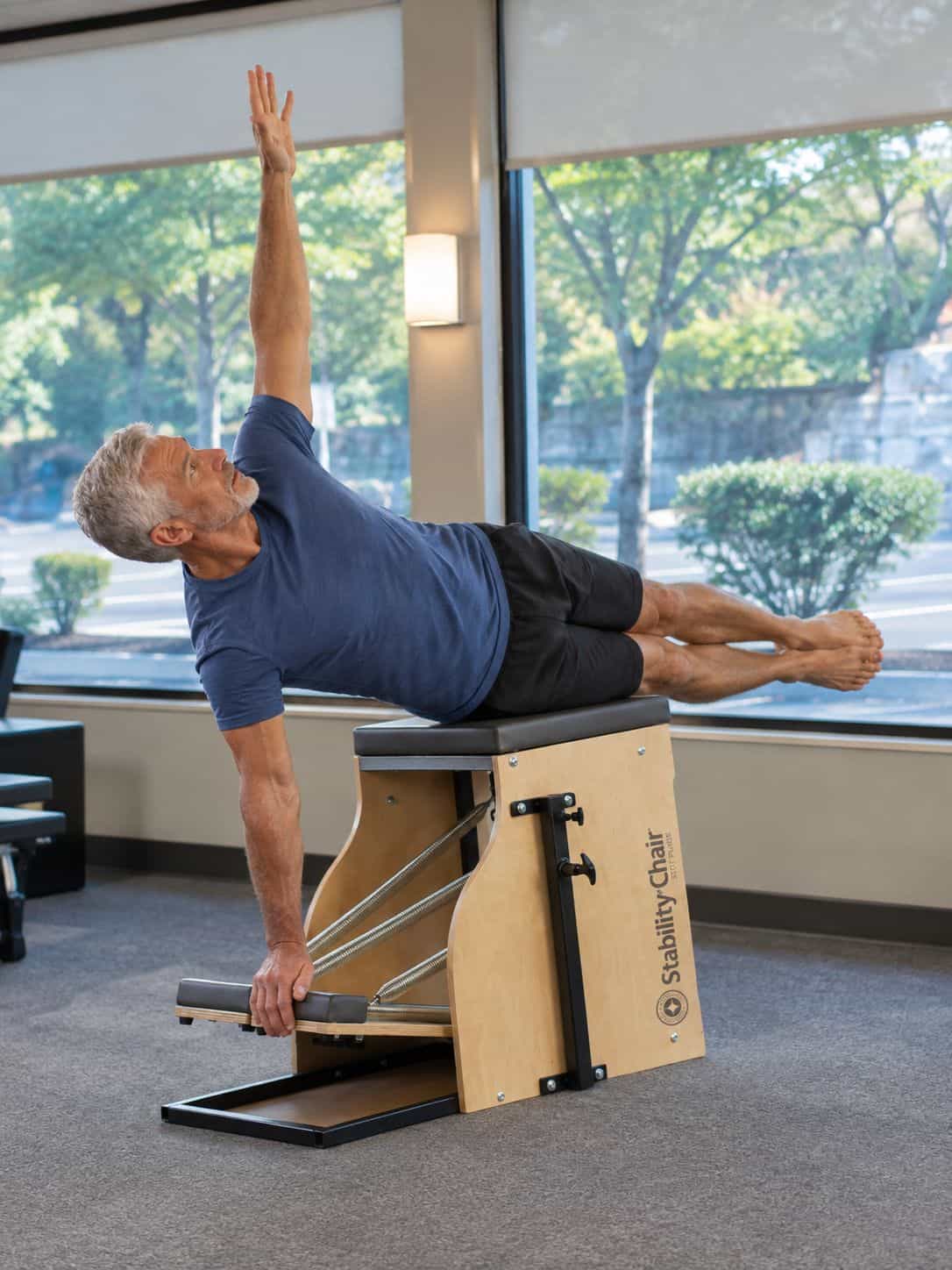
When did “hard” become the point of Pilates?
A recent Wall Street Journal article, “Gym Bros Are Going to Pilates—and Leaving Shaking Like a Chihuahua,” made us laugh.
Men accustomed to heavy lifting, CrossFit and HIIT are being brought to Pilates classes by their wives and girlfriends, confident they’re headed for a relatively easy workout. Instead, they find themselves shaking, sweating and struggling to keep up.
One man described walking in expecting a “cute little workout” and leaving with his legs shaking. Another, used to lifting very heavy weights, couldn’t manage seemingly simple bodyweight movements. Even the reporter fell off the Reformer during his first class.
You can read the full Wall Street Journal article HERE.
It’s funny.
But it also got us thinking about the men who aren’t new to Pilates. At Pacific Northwest Pilates, our Portland, Oregon studio, we have men who have practiced for years, some for two decades or more. They’ve long since stopped being surprised that Pilates is hard.
So we asked nine of the guys we see regularly at the studio: why do you actually do Pilates?
Their answers say a lot about what Pilates for men really looks like once the novelty wears off.
Want more stories like this in your inbox? Join our studio newsletter.
Why Is Pilates So Hard for Strong Men?
Pilates challenges control, stability and coordination through a full range of motion—skills that heavy lifting doesn’t always train.
Let’s get one thing out of the way: Pilates can be incredibly challenging. Strength in one context doesn’t automatically translate to strength, control or coordination in another.
Gary T., who has practiced Pilates since 2007, has made it something of a personal mission to get more men to try Pilates. He’s seen exactly what the WSJ describes, and he has a theory:
“Many of the guys that I have convinced to give it a try have commented on how difficult it was, and many gave up because it was just too hard. I think part of that is the male ego. The guys are struggling to perform an exercise and glance over and see a woman appearing to do the same exercise with ease. This does not set well with most guys.”
That’s insightful, and refreshingly honest.
Keith K. noticed the same gap from his very first class. The room was “mostly 95% women. I was expecting at least a few more guys.”
Both men are touching on something real. Pilates still has a reputation as exercise for women, and in most studios, women outnumber men. So a man walking in for the first time is often the newcomer in a room full of people who have been practicing for years.
What looks like ease is usually experience. The woman next to you making it look effortless has likely spent years learning to control her body, and that’s exactly the skill Pilates builds. It isn’t a competition, and it isn’t about who’s strongest. Everyone in the room is working on their own body, at their own level.
And the idea that Pilates is “for women” would have surprised its creator. Joseph Pilates was a lifelong athlete who developed his method in the early 20th century. So men “discovering” Pilates is, well, about a hundred years late.
Gary raised one more point worth sitting with: many of the men he brought “gave up because it was just too hard.” Making someone shake isn’t particularly difficult. A good instructor can make almost anyone exhausted. But hard for the sake of hard tends to send people home for good.
The men who stay with Pilates for years aren’t there for the shaking. So what are they there for?
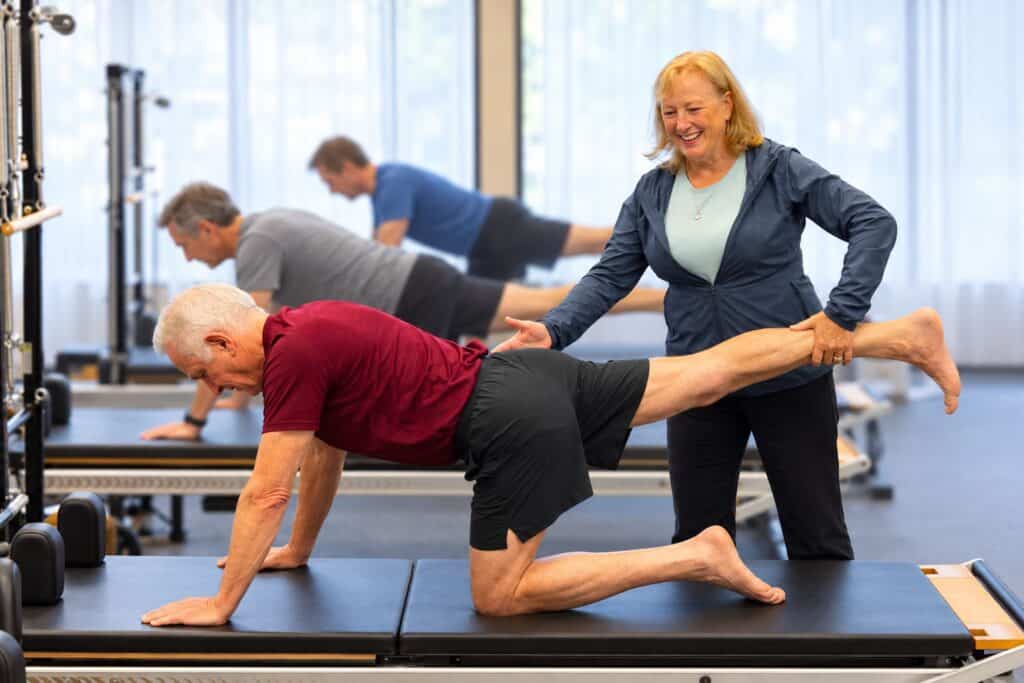
Why Do Men Start Pilates?
Most of the men we asked started because of back pain, advice from a physical therapist or teacher, or a wish to keep moving without the pounding.
Few men wander into Pilates by accident. For most of the men we asked, something sent them, and more often than not, it was their back.
Gary had been running marathons for more than 30 years when an orthopedic surgeon recommended fusing two of his vertebrae. He asked about alternatives. One of them was Pilates.
“Two years later, I went back to the same orthopedist and he said things had improved so much, while not perfect, he would not recommend surgery. I was basically pain free.”
Keith K. arrived with several lumbar herniations and severe sciatica. Randy L. traced his back trouble to years at a desk, and his push came from home: “My wife made me start doing it over 20+ years ago.” Just like the men in the Wall Street Journal story, only two decades earlier.
Others came because someone they trusted pointed the way. Roger B. started on his physical therapist’s recommendation, along with a warning to go very easy the first few times. Gabriel S. was steered to it by a college dance teacher.
And some were simply looking for a smarter way to stay strong. Doug S. had long been “beating myself up” in competitive contact and high-impact sports. As he approached 50, he wanted something that still pushed him, “but without the pounding.” Brad, who regularly takes group reformer classes, found he was “aging out of more rigorous gym workouts,” while John C. was looking for “something different to add to running and weights.”
Larry S. had perhaps the most interesting entry point of all. At a Pilates workshop, he heard that “some movements require turning off muscles as well as turning others on. That was the “lightbulb moment.”
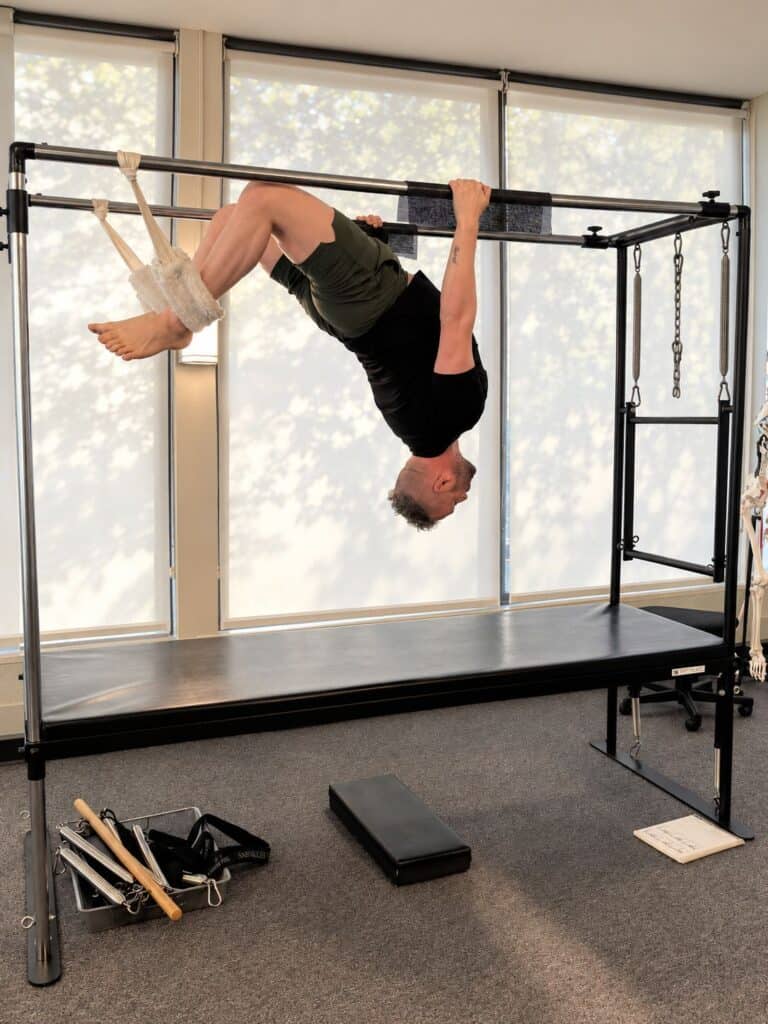
What Surprises Men About Pilates?
Control. Men who try Pilates find that lighter springs, slower movement and precision can be much harder than simply adding more weight.
Larry’s lightbulb moment turns out to be the thread running through nearly every answer we received. Gary described it this way:
“What surprised me most was how difficult something could be that looked so easy. I had to realize that it wasn’t all about adding the most springs to the apparatus, it often was about using the lightest springs to do the exercise. That took some mental adjustment. Guys think more weight is always going to be harder.”
So true! On the Reformer, lighter springs often mean less support, so your muscles have to do more of the controlling. It’s one of the most counterintuitive things about Pilates, and one of the most important.
That kind of control doesn’t come naturally to most of us, so the early days often involve some unlearning. For Randy, it meant having to “untrain the body from various bad habits.” Roger was candid, too: he was surprised by “how little ability I had to do many of the exercises correctly.”
This is the heart of it. A man who is very strong and very stiff usually doesn’t need more brute strength. He needs control, including knowing which muscles to turn off. That’s a humbling discovery. It’s also usually the beginning of real change.
Why Do Men Keep Doing Pilates?
Because it works. Men who stay with Pilates point to less pain, smarter strength and the ability to stay active with the people they love.
Ask these men why they’ve stuck with it, and the answers get refreshingly simple. “Because it works!” Gary told us. Doug said nearly the same thing, in capital letters: “It WORKS!” After nearly 20 years of Pilates, along with multiple knee surgeries and two torn rotator cuffs, he says he has “much more core, glute and leg strength than most men my age.”
Keith’s story shows what that kind of consistency looks like over time. He took therapeutic private sessions twice a week for 18 months “to heal and gain back athleticism,” then committed to weekly maintenance sessions “to make sure it stuck. And 20 years later, it did.”
For Gabriel S., the draw is the learning itself:
“I continue to practice Pilates because it is the best movement education I have yet to experience. The breadth and depth of the principles makes me a better mover and teacher in everything that I do.”
What keeps it working is progression. As Randy put it:
“There is always another level that can challenge you in a different way given the machines and exercises. Never feels repetitive.”
That’s exactly what progression should feel like. It’s also what concerns us about many high-intensity, Pilates-inspired workouts built on rote routines: same sequence, same pace, same goal of working everyone as hard as possible. That’s a very effective way to get tired. It isn’t a very effective way to progress.
Sometimes the payoff of real progression is close to home. For Brad, Pilates “keeps me moving and able to keep up with my grandsons.”
And sometimes it’s a leap of faith. Larry came home with a photo he was eager to share: a moment captured midair as he swan-dived off a bridge.
He was 79.

What Does Pilates Give Men That Other Workouts Don’t?
Pilates trains strength, mobility, balance and body awareness together, with movement itself as the goal rather than a side effect.
Most of these men do plenty of other things. They hike, golf, play pickleball, lift and train. So we asked what Pilates gives them that those activities don’t.
Larry described it as integration:
“Pilates continues to teach me what muscles to use when and to integrate the various components of my body into a better functional unit.”
That idea came up again and again. Brad called Pilates “the perfect combination of flexibility, balance and strength that allows me to lead an active, pain free life.” Keith values the “intense body awareness,” and the time it gives him to focus on “things I need to focus on, but sometimes don’t” in his other workouts.
In other words, Pilates isn’t competing with anything. It fills in what everything else leaves out.
There’s no shortage of ways to get exhausted. So why are we trying to turn Pilates into one more of them? When Pilates gets reshaped into another high-intensity workout, it mostly loses the very things these men value. We’d rather stay with what Pilates already does well, and keep doing it really well.
How Does Pilates Change the Way Men Think About Strength?
Working smarter, not just harder. Men who practice Pilates come to see strength as control, coordination and whole-body capability.
Roger summed up the shift in two sentences:
“It’s not just working harder to build strength. It’s working smarter, using muscles better.”
Doug sees the same change in his own training. Pilates, he says, has given him “an expanded and more balanced approach to strength and cardio training, while not damaging your joints or ligaments.” John noticed it in the details: “I pay more attention to form and function. Helps to prevent injuries.”
Keith was even more emphatic. Asked whether Pilates had changed how he thinks about strength, he answered:
“200%. Pilates is the necessary ‘module’ in my weekly workout schedule to keep it all going smoothly. It helps ensure my body is ready and moving well during all my other workouts.”
And sometimes the lesson is surprisingly specific. Randy “didn’t know how important ankle strength was to your overall balance and ability to move,” the kind of strength that keeps you steady on a hiking trail, a golf course or a pickleball court.
That’s what strength looks like when it’s built to last.
So… Have They Ever Left Pilates Shaking Like a Chihuahua?
Yes, at least now and then. Most of the men we asked admit to shaking mid-exercise, but for them it’s a side effect, not the goal.
We couldn’t resist asking.
Gabriel remembers shaking like a Chihuahua on his first attempts at The Hundred. Randy’s nemesis is “the fitness circle for inner thigh work!” Doug described shaking “in a good way from working muscles that often are neglected.” Brad insists he has never left class shaking, “except maybe after one of Melanie’s ‘therapeutic reformer’ classes.”
Keith didn’t hesitate: “Ha, weekly! ;-)”
And John? “Yes, but I’ll never admit it!”
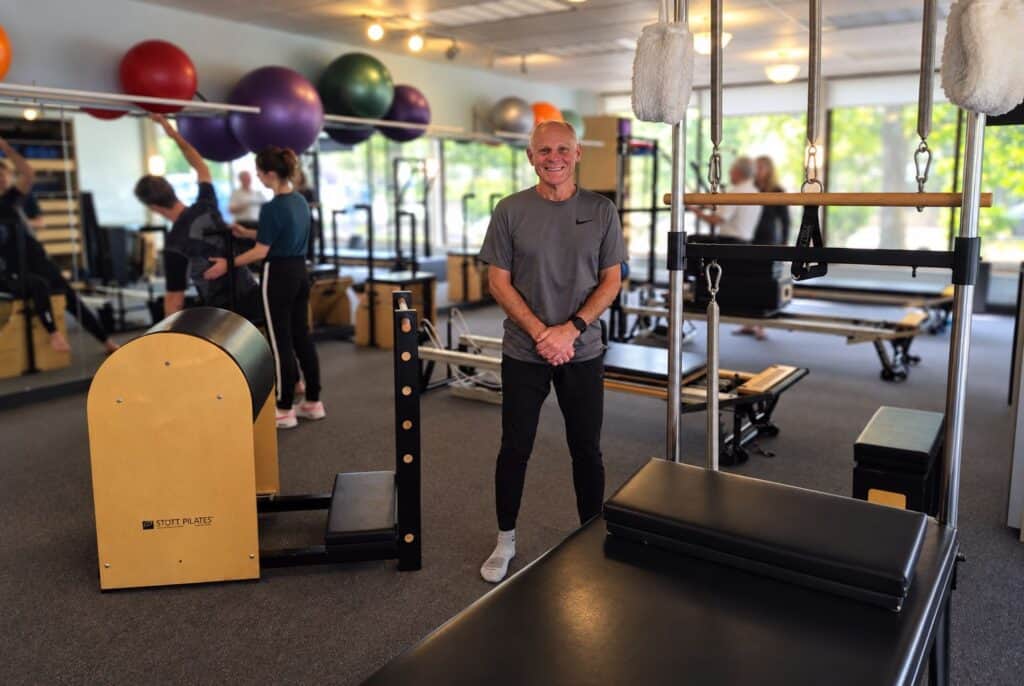
What the Men in Our Studio Already Know
We can laugh at stories of very fit men discovering that Pilates is harder than they expected. We certainly do.
But the men in our studio tell a different, quieter story. A marathoner who avoided spinal fusion. A man who healed his back and kept it healed for 20 years. A grandfather keeping up with his grandsons. A 79-year-old who jumped off a mountain. As Doug put it, Pilates is “challenging but also fun, uplifting for the spirit.”
None of them measure their practice by how badly their legs shake.
The goal isn’t to make Pilates as hard as possible.
The goal is to make the work appropriate, purposeful and effective for the person doing it.
Sometimes that will be incredibly hard.
Sometimes it won’t.
Knowing the difference is where the real work begins.
Curious what Pilates would feel like for your body? Every new client starts with a Starter Session, where we learn your history, look at how you move and help you find the right fit, whether that’s private sessions or one of our small group classes capped at six people.
Frequently Asked Questions About Pilates for Men
Is Pilates hard for men who lift weights?
Often, yes. Lifting builds strength in specific patterns, while Pilates asks for control, stability and coordination through a full range of motion. Many strong lifters find that combination surprisingly challenging at first.
Can Pilates replace weight training?
Not entirely, and it doesn’t have to. Think of exercise like a balanced diet. We all need cardio, strength, mobility, agility and balance to help prevent falls, and control through a full range of motion. Pilates does several of these better than most activities, but it doesn’t replace cardio or heavy lifting. Like a healthy diet, you need all of it. A good instructor can help you find the right mix for your goals.
Is Pilates good for men over 50?
Yes. Pilates supports strength, balance, posture and mobility, which matter more with each decade. Because exercises can be adapted precisely, it’s also a good fit for men with past injuries, surgeries or stiff backs.
Do I need to be flexible to start Pilates?
No. Flexibility is something Pilates helps you develop, not a requirement to begin. Instructors adjust range of motion and spring settings so the work meets you where you are today.
How do I start Pilates in Portland?
At Pacific Northwest Pilates, every new client begins with a Starter Session. Your instructor learns your history and goals, assesses how you move and recommends private sessions or small group classes.