
If you’ve always been the “bendy one” in your family, or you’ve noticed that certain stretches feel suspiciously effortless while other people are straining, you may have wondered whether there’s a name for that. There is — it’s called joint hypermobility — and one of the most common ways to screen for it is a quick, nine-point test called the Beighton Score.
It’s a genuinely useful tool. It’s also frequently misunderstood, and at Pacific Northwest Pilates in Portland, Oregon, it’s a question our instructors hear often, from lifelong yogis to former dancers to people who simply never gave their unusually flexible joints a second thought until something started to hurt. So let’s walk through what the Beighton Score actually measures, what it can’t tell you, and — more importantly — what it means for how you move and exercise.
What Is Joint Hypermobility, Exactly?
Joint hypermobility means one or more joints move beyond what’s considered a typical range of motion — and on its own, it isn’t a diagnosis or a problem.
It’s worth separating two ideas that often get blended together: flexibility and hypermobility. Flexibility usually refers to overall range of motion, including how much your muscles can lengthen. Joint hypermobility specifically refers to the joints themselves moving farther than expected — a double-jointed thumb, a knee that hyperextends, elbows that bend backward past straight.
Being hypermobile does not automatically mean something is wrong. Plenty of people are hypermobile without any pain, instability, or symptoms at all. For others, though, hypermobility shows up alongside pain, joint instability, fatigue, recurring injuries, or difficulty controlling movement through a joint’s full range. That distinction matters, and we’ll come back to it.
What Is the Beighton Score?
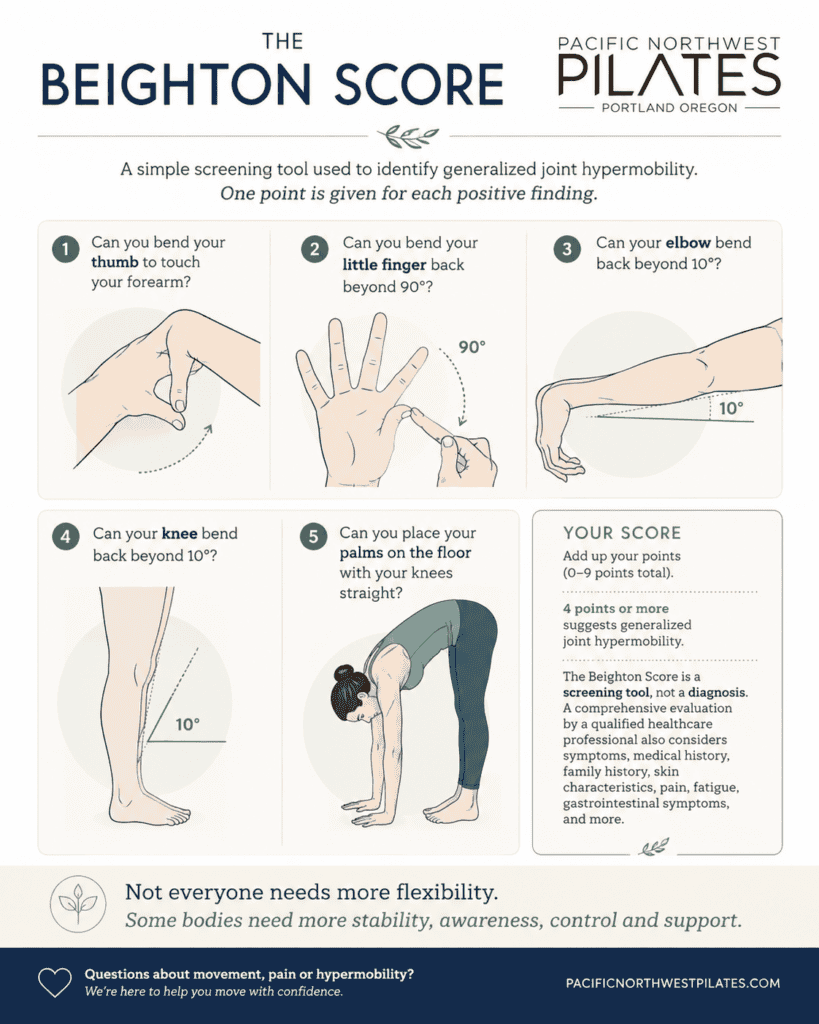
The Beighton Score is a simple nine-point screening test that checks five movements — several on both sides of the body — to flag generalized joint hypermobility.
It’s been used by clinicians and researchers for decades because it’s fast, requires no equipment, and gives a rough, standardized snapshot. The five movements assessed are:
- Bending the little finger backward past 90 degrees
- Bending the thumb back to touch the forearm
- Hyperextending the elbow
- Hyperextending the knee
- Bending forward with straight legs to place palms flat on the floor
Because the little fingers, thumbs, elbows, and knees are each scored on both the left and right side, the test awards up to nine total points — one point for each side that meets the criteria, plus one point for the forward bend.
So What Does Your Beighton Score Actually Mean?
A higher Beighton Score suggests generalized joint hypermobility, but the “cutoff” for what counts depends on age, and the score is meant as a screening tool, not a final answer.
The commonly cited thresholds shift depending on who’s being tested — children and teenagers are naturally more mobile than adults, and mobility tends to decrease with age. That’s part of why a single number doesn’t tell the whole story.
Here’s something we see constantly working with clients in Portland: your Beighton Score today may not reflect what your joints were doing twenty years ago. Someone who was remarkably flexible in their twenties may score lower now because of age, past injury, surgery, arthritis, or simply the adaptations their body has made over the years. A lower score doesn’t necessarily mean hypermobility was never present — it may just mean it’s less visible on this particular test, on this particular day.
What the Beighton Score Doesn’t Tell You
The Beighton Score screens for excess range of motion in five joints — it doesn’t assess pain, joint stability, control, or whether you have a diagnosable connective tissue condition.
This is, honestly, the part of the conversation we think is most useful — and most often left out. The Beighton Score is a helpful starting point, but on its own, it doesn’t tell you:
- Whether you’re experiencing pain
- Whether a joint feels unstable or “gives way”
- How well you can control your available range of motion
- Whether you’ve had subluxations or dislocations
- How your shoulders, hips, feet, spine, or jaw behave — none of those joints are part of the test
- Whether hypermobility is affecting your daily life
- Why you’re hypermobile in the first place
That last point matters a lot. The Beighton Score is not a diagnosis of Ehlers-Danlos syndrome (EDS) or Hypermobility Spectrum Disorder (HSD). Those are separate clinical diagnoses made by qualified healthcare providers, typically involving a broader evaluation than five quick movements. A high Beighton Score can be one small piece of that picture — but it isn’t the picture itself.
Why Does Hypermobility Matter When You Exercise?
Hypermobile joints often benefit from training that prioritizes control and stability over simply reaching maximum range, so the joint has support at the end of its motion, not just flexibility.
This is where the conversation often goes sideways. “You’re flexible, so you probably shouldn’t stretch” is an oversimplification — and honestly, not always true. What tends to matter more is how much control someone has through their available range, and whether the muscles around a joint can organize and support it, especially at end range.
A thoughtful instructor working with a hypermobile client tends to pay attention to things like:
- Joint positioning and alignment during exercises
- Proprioception — your body’s sense of where a joint is in space
- Controlled range rather than maximum range
- Appropriate loading, so muscles are actually doing their job
- Compensatory movement patterns that may be masking instability elsewhere
- How the person’s body feels and responds on that particular day
This is where Pilates tends to be genuinely relevant — not because Pilates “cures” hypermobility (it doesn’t, and we’d never claim that), but because a well-designed Pilates practice offers a lot of opportunities to build strength, control, and body awareness around a joint’s range, rather than just moving through it. That’s a meaningfully different goal than a stretch-focused workout, and it’s part of why our therapeutic and specialized instructors approach hypermobile clients differently from clients working on general flexibility.
“But I’m Flexible and I Feel Fine”
Great — genuinely. Hypermobility isn’t inherently a problem, and we don’t want this article to make anyone feel like they need to be worried about being bendy. Plenty of dancers, gymnasts, athletes, and everyday people have hypermobile joints and move through life without a single issue.
The reason to pay closer attention is when extra range of motion shows up alongside pain, instability, recurring injuries, difficulty controlling movement, or joints that feel unpredictable. If none of that applies to you, this is simply useful information about how your body works — not a warning sign.
What Should I Do If I Think I’m Hypermobile?
If hypermobility comes with pain, instability, or recurring injury, start with a qualified healthcare provider; for exercise, look for an instructor who understands how to train around it.
If you’re noticing pain, repeated injuries, joints that feel unstable, subluxations, dislocations, or other concerning symptoms, that’s worth bringing to an appropriately qualified healthcare provider — a physician, physical therapist, or specialist familiar with hypermobility-related conditions.
For exercise, it’s worth working with an instructor who understands hypermobility and looks beyond simply how far you can move. At Pacific Northwest Pilates, our Specialized Pilates and Therapeutic Pilates sessions are built around exactly this kind of individualized assessment — understanding not just your range of motion, but your history, your goals, and how your body actually behaves under load.
If that sounds like you, our Hypermobility class meets Thursdays at 4pm at Pacific Northwest Pilates in Portland, taught by instructor Lisa Buchmiller. It’s designed for anyone who’s a little more bendy, or anyone who simply wants to slow down and work in smaller, more controlled ranges. Lisa emphasizes stabilization, modifies exercises to fit each body in the room, and teaches you how to release unwanted tension and use props for support. Part of each class is exploratory — using movement and discussion to build proprioception and balance — so you leave with a better sense of what your body actually needs, not just a workout you got through.
See Thursday’s Hypermobility class on our full schedule →
Frequently Asked Questions
Is a high Beighton Score bad?
Not necessarily. A high score simply indicates more range of motion than average in the five tested joints. It only becomes a concern when it’s paired with pain, instability, or difficulty controlling movement.
Can the Beighton Score diagnose Ehlers-Danlos syndrome (EDS)?
No. The Beighton Score is a screening tool for generalized joint hypermobility. EDS and Hypermobility Spectrum Disorder (HSD) are separate clinical diagnoses that require evaluation by a qualified healthcare provider.
Should hypermobile people stretch less?
Not automatically. What tends to matter more is building control and strength through the available range, rather than simply avoiding movement. This is best worked out individually with a knowledgeable instructor.
Does hypermobility change with age?
Yes. Joint range of motion generally decreases with age, injury, or surgery, so someone’s Beighton Score today may be lower than it was decades earlier — even if hypermobility was always present.
For Movement Professionals
Interested in learning more about working with hypermobility? Pacific Northwest Pilates co-owner and STOTT PILATES® Rehabilitation Master Instructor Trainer Melanie Byford-Young is joining physical therapist and Taming the Zebra author Heather Purdin for an upcoming online workshop exploring safe and effective exercise for HSD and EDS.