
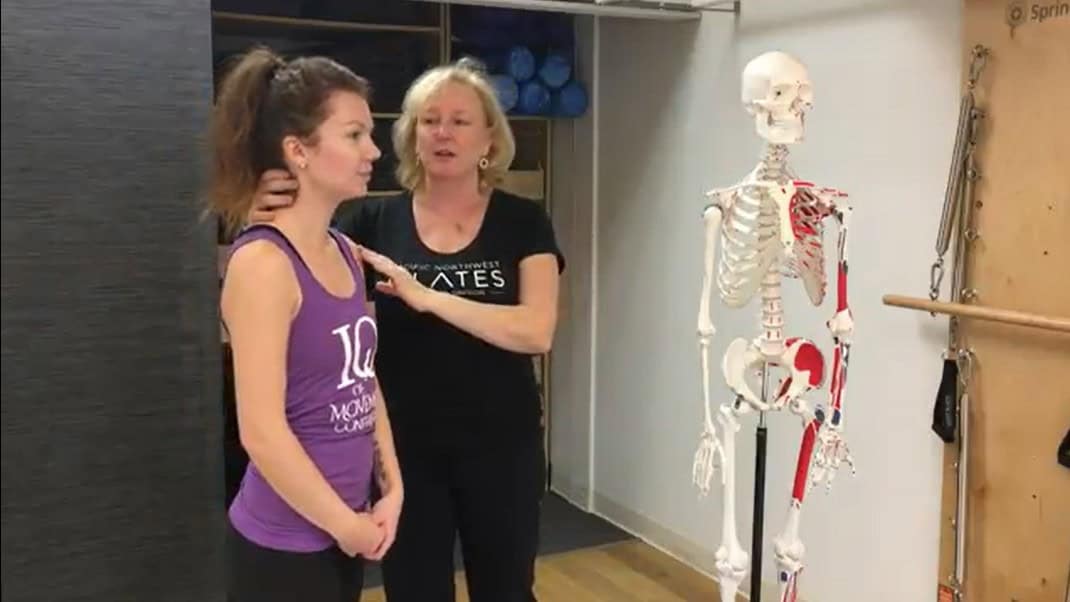
You’ll see it constantly once you start teaching: a client walks in with their head sitting noticeably forward of their shoulders. You may know this pattern by its more casual name, tech neck, but the instinct when you see it is usually the same. Treat it like a position to correct. Put a hand on the back of their head, guide it back over the shoulders, problem solved.
Forward head posture often involves real tension at the neck itself, but the neck’s structures are small compared to the hips and back. Work the neck alone while those bigger muscles keep pulling, and the correction won’t hold.
STOTT PILATES® Master Instructor Trainer of Rehabilitation Melanie Byford-Young, co-owner of Pacific Northwest Pilates in Portland, Oregon and one of PNWPE’s instructor trainers, has a short teaching explanation of exactly why this matters that’s stuck with us long after we first heard it. Her point isn’t that the neck is never involved. It’s a question of scale and sequence: the muscles at the neck are small compared to the muscles at the hip and back that are often pulling the head forward in the first place. Chase the local fix without addressing the bigger pull, and you’re working against a much stronger system.
What’s Actually Pulling the Head Forward?
Forward head posture is often driven by tightness in the hip flexors, the lower back extensors, or the chest and upper back muscles, working alongside whatever is happening at the neck itself.
Byford-Young points to three usual suspects, sometimes acting alone, often acting together:
Tight hip flexors. When the muscles at the front of the hip are gripping, they pull the whole posterior chain along with them, and the head ends up riding forward as part of that chain reaction.
Gripping low back extensors. Tension in the muscles along the spine, especially where the upper and lower back meet, can shove the head forward as a side effect of that compression.
Tight chest and upper back muscles. When the muscles across the front of the shoulders and upper back are short, they round the shoulders forward and pull the head along with them.
Here’s the part that’s easy to miss: the muscle at the front of the neck (the sternocleidomastoid or SCM) most people assume is doing the damage is often just responding to a bigger pull. Once the body is being pulled down by the hips, the low back, or the chest, that SCM can shift roles, from a mover into a compressor, holding the head in a position the bigger structures put it in. That doesn’t mean the neck is off the hook. It means the neck work alone is unlikely to succeed if the larger pull is still active.
Why Decompression Has to Come First
This is the sequencing that makes Byford-Young’s explanation so useful for newer instructors. It’s not “ignore the neck.” It’s “don’t only work the neck.”
Address the larger pull first when you can. Find and release whatever is pulling the system down, whether that’s the hips, the low back, or the chest. These structures are bigger and stronger than anything at the neck, so they tend to win that tug-of-war by default.
Then refine locally at the neck. Once the bigger pull is addressed, the fine-tuning work at the cervical spine has a real chance to hold, instead of being undone the moment the client moves again.
Without that step, the local neck work has a much harder job. You can program excellent cervical spine exercises, but if the hip flexors are still gripping every time the client moves, the head is likely to keep getting pulled back into the same position. Scale matters here: the neck is being asked to hold its own against muscle groups several times its size.
The Bigger Skill This Points To
This is a small example, but it’s a preview of a much bigger skill: learning to look past the obvious compensation and find what’s actually driving it. That skill doesn’t come from memorizing which muscle does what. It comes from practicing pattern recognition, again and again, on real bodies, until tracing a postural habit back to its source starts to feel less like detective work and more like instinct.
That’s exactly the kind of practice PNWPE built this September’s workshop lineup around. The workshops run online, so instructors anywhere can join, but the curriculum comes straight from our home studio’s instructor trainers here in the Pacific Northwest.
We share teaching breakdowns like this one first with our newsletter list, often with more depth than what ends up on the blog. If you want those in your inbox, you can sign up here.
This September, PNWPE is running a set of workshops that build directly on what’s covered here, including Cueing & Modifications on the Reformer® for clients with postural issues and Beyond the Biomechanical Principles. All are open to instructors regardless of certification background.